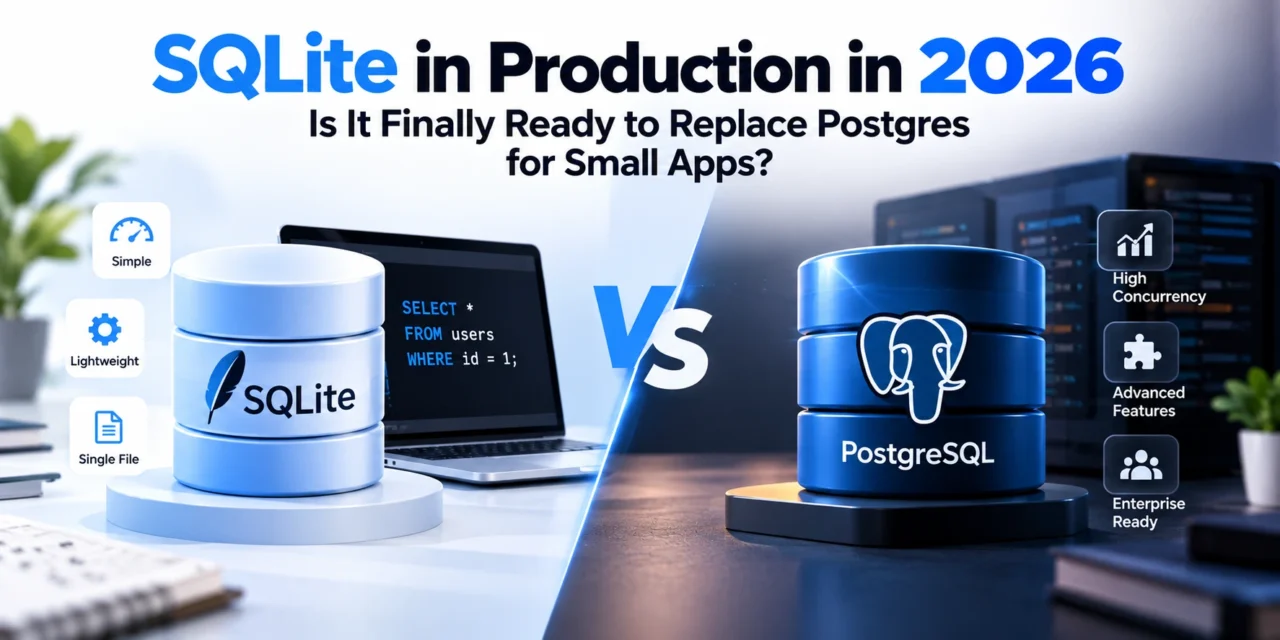
SQLite has spent most of its history as the database quietly embedded inside a mobile app or browser, never seriously considered for an actual production web server the way PostgreSQL or MySQL have been. Projects like Litestream and LiteFS, which add real-time replication on top of SQLite’s simple single-file database, alongside libSQL and Turso’s edge-deployment tooling, have genuinely changed that conversation in recent years. By 2026, enough teams have shipped real production services on SQLite that it’s worth asking honestly whether it’s actually ready to replace Postgres for the right kind of application. Here’s an honest look at where SQLite in production actually stands this year.
What Has Genuinely Changed
SQLite’s traditional dealbreaker for production use was the lack of built-in replication, since a single-file database sitting on one server represented a genuine single point of failure with no straightforward path to redundancy. Litestream solves this by continuously streaming SQLite’s write-ahead log to cloud object storage, enabling genuine point-in-time recovery and replication without requiring an application to change how it talks to the database at all. LiteFS takes this further, enabling genuinely distributed SQLite deployments where multiple application instances across different regions can each read from a local replica while writes get forwarded to a single primary, and Turso’s libSQL fork extends SQLite specifically for edge deployment scenarios where a database needs to live physically close to users worldwide.
Where SQLite Genuinely Excels
SQLite’s core architecture gives it real advantages for read-heavy or single-writer applications, since reads can be served directly from local disk with no network round trip at all, delivering genuinely lower latency than a traditional client-server database requires for every single query. Its simplicity, an entire database as a single portable file, makes backup, testing, and local development considerably more straightforward than managing a separate database server process, removing genuine operational overhead for smaller teams. For applications with a genuinely bounded, predictable write pattern, a single background job writing data that many more processes read, SQLite’s architecture fits naturally without requiring the operational overhead a full client-server database demands.
Where Postgres Still Genuinely Wins
SQLite’s concurrency model remains a genuine, honest limitation for write-heavy applications, since it fundamentally serializes writes even with newer replication tooling layered on top, meaning applications with many simultaneous writers competing for the same data will hit real contention that a properly configured Postgres deployment handles considerably more gracefully. Complex, multi-tenant applications needing sophisticated row-level security, advanced indexing strategies, or genuinely complex query optimization still benefit from Postgres’s considerably more mature query planner and decades of production hardening at massive scale. Teams needing genuinely advanced features, full-text search at scale, complex JSON querying, geospatial data, PostGIS-style extensions, will still find Postgres’s mature extension ecosystem considerably more capable than SQLite’s more limited feature set.
Should Your Team Actually Adopt It Now
For genuinely read-heavy applications, content sites, internal tools, single-tenant SaaS products with a bounded, predictable write pattern, SQLite paired with Litestream or LiteFS represents a legitimate, increasingly well-tooled production option in 2026 that meaningfully reduces operational complexity compared to running a separate Postgres server. Applications with genuinely high write concurrency, complex multi-tenant data isolation needs, or requirements for Postgres-specific advanced features are unlikely to find SQLite a suitable replacement regardless of how much the replication tooling has matured, since these limitations are architectural rather than simply a matter of insufficient tooling. As with most infrastructure decisions, the right question isn’t whether SQLite has gotten genuinely more production-capable, it clearly has, but whether a specific application’s actual concurrency and feature needs fall within the real, honest boundaries of what SQLite’s architecture can support.
Looking at where SQLite in production actually stands after genuine adoption by teams building real services on it, the honest assessment is that it has earned a legitimate, if bounded, place in the production database conversation for small-to-mid-sized, read-heavy applications, without genuinely displacing Postgres for the broader universe of write-heavy or feature-demanding applications. The teams getting real value from production SQLite are those whose actual workload genuinely matches its single-writer, read-heavy architectural strengths, not teams adopting it purely to simplify operations without checking whether their write patterns actually fit. As Litestream, LiteFS, and Turso’s libSQL ecosystem continue maturing, expect SQLite’s practical production ceiling to keep rising gradually, though its fundamental single-writer architecture means Postgres will likely remain the safer default for genuinely write-heavy or complex multi-tenant applications for the foreseeable future.
Conclusion
SQLite has made genuine, tooling-backed progress toward production viability in 2026, and for the specific category of read-heavy, single-writer applications, Litestream and LiteFS have made it a legitimate, operationally simpler alternative to running a full Postgres server. It isn’t a wholesale replacement for Postgres, and write-heavy or feature-demanding applications will still need Postgres’s genuine concurrency and extension maturity, but for the right kind of small-to-mid-sized application, this year’s mature SQLite production tooling has made it a credible default worth serious evaluation rather than a purely mobile-only curiosity.