
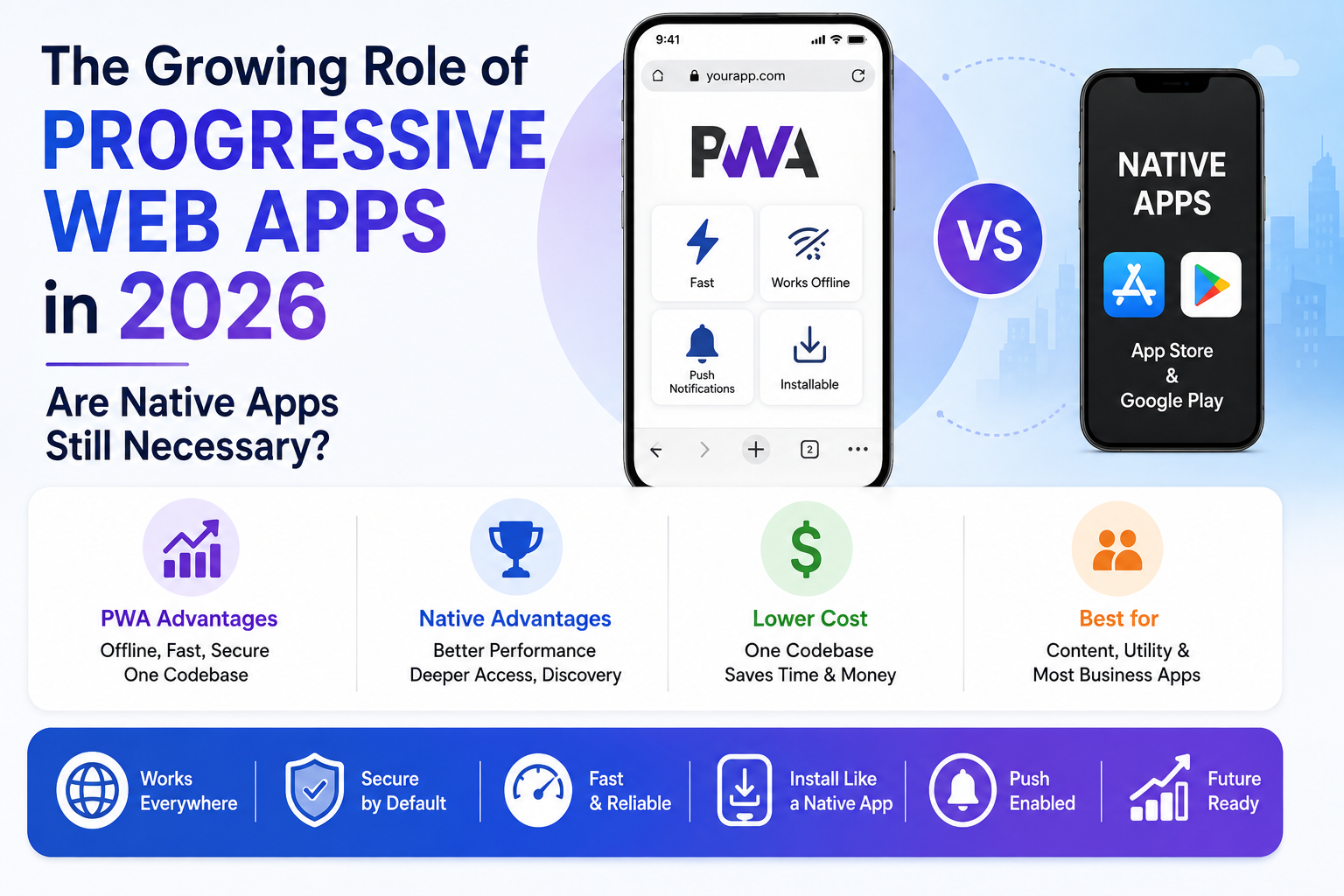
Progressive web apps have promised for years a genuinely appealing alternative to native development, a single web-based codebase that installs like an app, works offline, and sends push notifications without needing separate iOS and Android builds maintained in parallel. By 2026, browser support and platform capability for PWAs have improved considerably, and it’s worth taking a genuinely practical look at whether native apps remain necessary for most businesses or whether PWAs have closed the gap enough to become the more sensible default choice. This breakdown focuses on that practical business decision rather than a purely technical comparison disconnected from actual budget and resource constraints.
Where PWAs Have Genuinely Improved
Modern PWAs now support genuinely capable offline functionality, push notifications, and home screen installation across most major platforms, closing much of the practical gap that once made native apps clearly necessary for basic app-like functionality.
Where Native Apps Still Hold a Real Advantage
Native apps retain genuine advantages in accessing certain device hardware features, achieving the smoothest possible performance for graphics-intensive applications, and benefiting from app store discovery that PWAs largely bypass entirely.
The Real Cost Calculation for Businesses
Building and maintaining one PWA codebase costs genuinely less than separate native iOS and Android development, making PWAs an increasingly sensible default specifically for businesses without the resources for parallel native development.
What This Means for Different Types of Apps
Content-driven businesses, informational sites, and simpler utility apps increasingly find PWAs genuinely sufficient, while apps requiring deep hardware integration, competitive gaming performance, or heavy app store discovery still benefit meaningfully from native development.
The practical decision for most businesses increasingly comes down to genuine resource constraints and specific feature needs rather than a strict native-versus-PWA ideological choice. Smaller businesses and startups without the resources for separate native development teams increasingly find PWAs a genuinely sensible way to reach both mobile and desktop users from one codebase. Businesses specifically depending on app store discovery for new user acquisition still need a native app presence, since PWAs largely remain invisible to typical app store browsing behavior. Applications requiring the smoothest possible performance, like competitive mobile games, still benefit meaningfully from native development’s tighter hardware access. This trend connects to a broader pattern of platform evolution discussed in earlier coverage of cross-platform development approaches, where the right technical choice increasingly depends on specific business constraints rather than one universally correct answer. Reassessing this decision periodically also matters, since browser and platform PWA support continues to genuinely improve year over year.
Progressive web apps have genuinely closed much of the practical gap with native development, making them an increasingly sensible default for businesses without the resources for separate native app development. Native apps remain genuinely necessary specifically for app store discovery, deep hardware access, or maximum performance, meaning the right choice increasingly depends on a specific business’s actual constraints and priorities rather than one universally correct answer for every situation. Testing a PWA prototype against real users before committing to either path fully tends to reveal which specific limitations actually matter for a given audience, often more clearly than any theoretical comparison of the two approaches ever could, since real usage patterns tend to expose genuine friction points a spec sheet comparison alone would never reveal ahead of time, especially once real customers start interacting with the product daily.