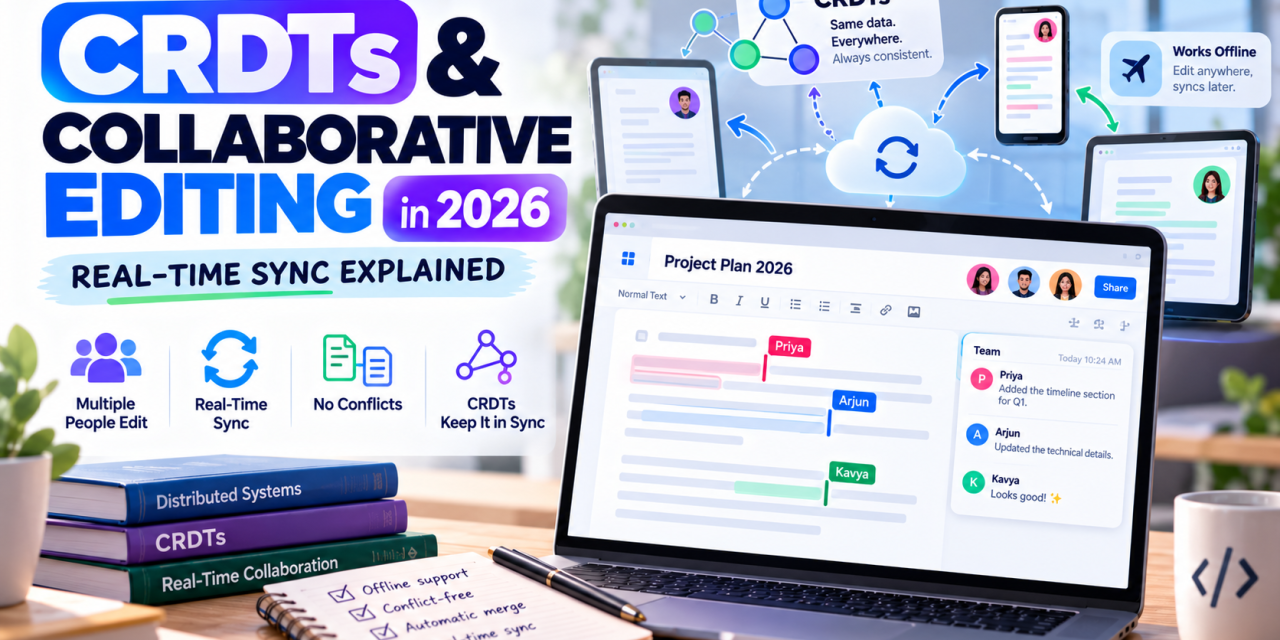
Multiple people typing simultaneously in the same shared document, each seeing the other’s edits appear in real time with no confusing conflicts or lost changes, seems close to magic the first time anyone actually experiences it, and Conflict-free Replicated Data Types, or CRDTs, remain the core technical mechanism making that experience genuinely possible at scale. By 2026, CRDTs have moved well beyond a research curiosity into genuinely production-proven infrastructure powering real-time collaboration across a wide range of applications beyond just Google Docs. Here’s an honest look at how this technology actually works and where its real limits remain.
The Core Problem CRDTs Actually Solve
Real-time collaborative editing faces a genuinely hard distributed systems problem: when two people edit the same document simultaneously, potentially while briefly disconnected from each other’s changes, the system needs a mathematically guaranteed way to merge both sets of edits back into a single, consistent final result without requiring a central server to make an ambiguous, potentially unfair judgment call about whose edit wins. CRDTs solve this by designing the underlying data structure so that operations are mathematically commutative, meaning applying two conflicting edits in either order always produces the same final, consistent result, removing the need for a central authority to arbitrate between them. This mathematical guarantee is what lets a collaborative document genuinely converge to the same state across every connected device, even when edits arrive out of order or after a temporary disconnection.
CRDTs Versus Operational Transformation
Operational Transformation, the older technique that originally powered early collaborative editors including Google Docs itself, takes a genuinely different approach, transforming each incoming operation based on other operations that happened concurrently, requiring a central server to maintain a single authoritative operation history that all clients synchronize against. CRDTs remove that central server dependency entirely, letting any two replicas merge their changes directly with each other and still guarantee mathematical consistency, a genuinely more robust property for applications needing true peer-to-peer or offline-first collaboration rather than requiring constant connectivity to a central coordinating server. This distinction matters enormously for local-first applications specifically, since a CRDT-based document can genuinely be edited entirely offline and merged correctly later, a guarantee that traditional Operational Transformation’s server-dependent model doesn’t provide as cleanly.
The Real Engineering Tradeoffs Involved
CRDTs genuinely carry a real storage overhead cost, since the data structure needs to retain enough metadata about the history of operations to guarantee correct merging, meaning a CRDT-based document can require meaningfully more storage than the equivalent plain text alone, a tradeoff that matters for applications with genuinely large documents or extremely long edit histories. Performance at very large document scale also remains a genuine, actively researched engineering challenge, since naively implemented CRDTs can experience real performance degradation as a document’s operation history grows extremely long, requiring specific optimization techniques like periodic history compaction to keep performance genuinely acceptable at scale. Libraries like Yjs and Automerge have matured considerably in addressing these performance concerns, but teams building genuinely large-scale collaborative applications still need to actively account for these real, well-documented tradeoffs rather than assuming CRDTs are a costless solution.
Should Your Application Actually Use CRDTs Now
For applications genuinely requiring true offline-first editing, peer-to-peer collaboration without a mandatory central server, or robust merging across unreliable network conditions, CRDTs represent a legitimate, increasingly well-tooled architectural choice in 2026, with mature libraries removing much of the earlier implementation burden. Applications with more modest collaboration needs, occasional shared editing with generally reliable connectivity and no genuine requirement for true offline capability, may find a simpler, server-authoritative approach, potentially still using Operational Transformation or an even simpler locking mechanism, genuinely sufficient without needing CRDTs’ additional storage overhead and implementation complexity. As with most architectural decisions, the right question isn’t whether CRDTs are impressive distributed systems engineering, they clearly are, but whether a specific application’s actual connectivity assumptions and collaboration requirements genuinely justify the real tradeoffs this technology introduces.
Looking at where CRDTs and collaborative editing actually stand after genuine production maturity through 2026, the honest assessment is that this technology has moved decisively from an academic curiosity into legitimate, well-tooled infrastructure for applications with a genuine need for offline-first or truly peer-to-peer collaboration, while remaining a real, deliberate architectural tradeoff rather than a universally superior default for every collaborative feature. The teams getting genuine value from CRDTs are those with an actual offline or peer-to-peer requirement driving the decision, not teams adopting the technology simply because Google Docs-style real-time collaboration sounds impressive to offer. As libraries like Yjs and Automerge continue maturing their performance characteristics at scale, expect CRDT adoption to keep expanding into applications that previously found the storage and complexity tradeoffs too costly to justify.
Conclusion
CRDTs have made genuine, production-proven progress powering real-time collaborative editing in 2026, moving well beyond Google Docs into a broad range of applications that genuinely need offline-first or peer-to-peer collaboration guarantees. It isn’t a costless architectural choice, and the storage and performance tradeoffs are real, but for applications with a genuine offline or peer-to-peer requirement, this year’s mature CRDT libraries have made the technology a legitimate, well-supported default rather than an intimidating research topic reserved only for the largest tech companies.