Rust and Go have both carved out genuinely strong, growing reputations in backend and systems programming, but they’ve done so by solving somewhat different problems well rather than competing head-to-head for the exact same use cases the way some framework rivalries do. Go built its reputation on simplicity and fast compilation for building network services and cloud infrastructure tools, while Rust has become the language of choice for performance-critical systems where memory safety without a garbage collector genuinely matters. By 2026, both languages have matured into production-proven choices at serious scale, and the question of which to learn first depends heavily on the specific kind of backend work a developer actually wants to do. This breakdown focuses on that practical fit rather than treating the comparison as a scoreboard with one clear overall winner.
Where Go Wins
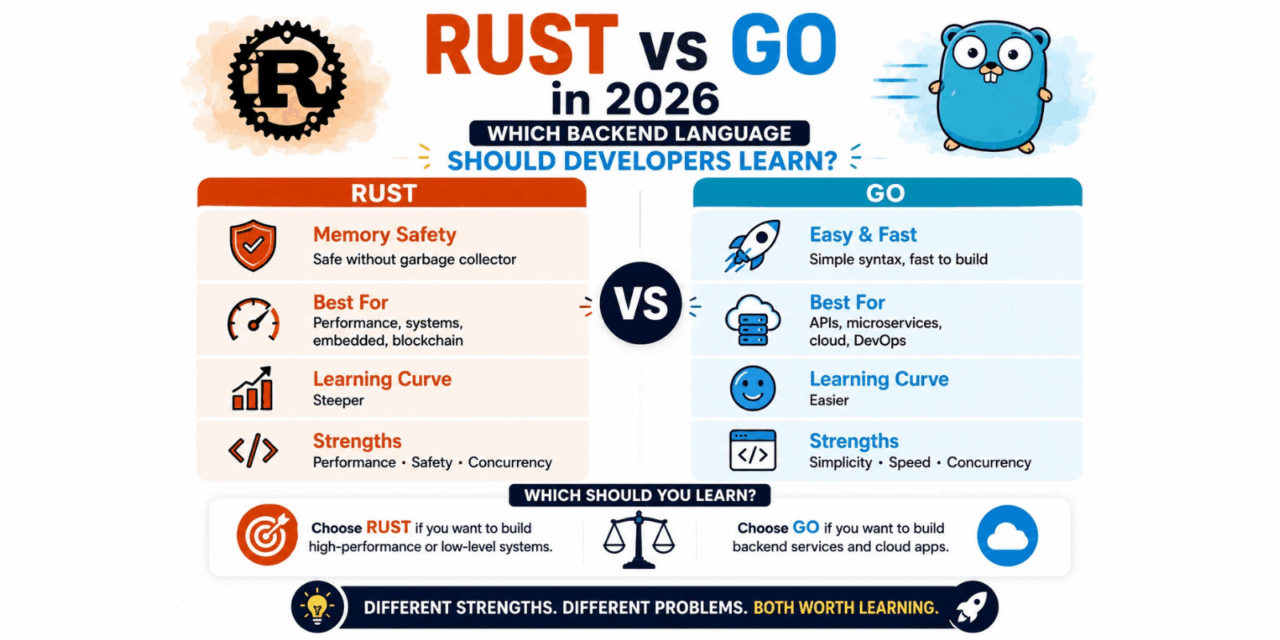
Go’s deliberately simple syntax and fast compile times make it genuinely easier to learn and immediately productive with, and its strong standard library and built-in concurrency model make it a natural fit for building network services and APIs quickly.
Where Rust Wins
Rust’s ownership model guarantees memory safety without a garbage collector, making it the stronger choice for performance-critical systems, embedded programming, and situations where precise control over memory genuinely matters for correctness or speed.
Learning Curve Differences
Go’s simplicity means most developers reach genuine productivity within weeks, while Rust’s ownership and borrowing rules present a real, well-documented learning curve that takes considerably longer to internalize even for experienced programmers coming from other languages.
What New Developers Should Actually Learn
Developers targeting typical backend API and cloud infrastructure work are generally better served starting with Go given its faster learning curve and strong job market demand in that specific space, while those targeting systems programming, performance-critical services, or blockchain development should seriously consider Rust despite its steeper initial learning curve.
The choice genuinely depends more on the specific kind of backend work targeted than on which language is objectively better in some abstract sense, since Go and Rust were built to solve meaningfully different problems well rather than compete directly for identical use cases. Developers building typical CRUD APIs, microservices, or cloud infrastructure tooling get more immediate practical value and faster job market entry from Go’s simplicity and widespread adoption in that specific space. Developers interested in systems programming, high-performance computing, or industries where memory safety without garbage collection genuinely matters, like certain fintech or blockchain applications, find Rust’s steeper learning curve genuinely worth the investment for those specific roles. Both languages are increasingly taught alongside each other in serious backend engineering programs, suggesting the industry increasingly views them as complementary tools for different jobs rather than direct competitors. Reading real production code written in each language, rather than just tutorial examples, tends to reveal these practical strengths and weaknesses far more clearly than any single comparison article can.
Go’s simplicity and fast learning curve make it the more approachable starting point for most developers entering typical backend and cloud infrastructure work, while Rust rewards the additional investment for developers specifically targeting performance-critical or systems-level programming. The most valuable backend developers increasingly understand when each language’s specific strengths actually apply, rather than treating this as a permanent, one-size-fits-all choice between rival camps. Learning the basics of both, even without deep mastery of either, gives a developer a genuinely useful vocabulary for evaluating which tool actually fits a given project.