
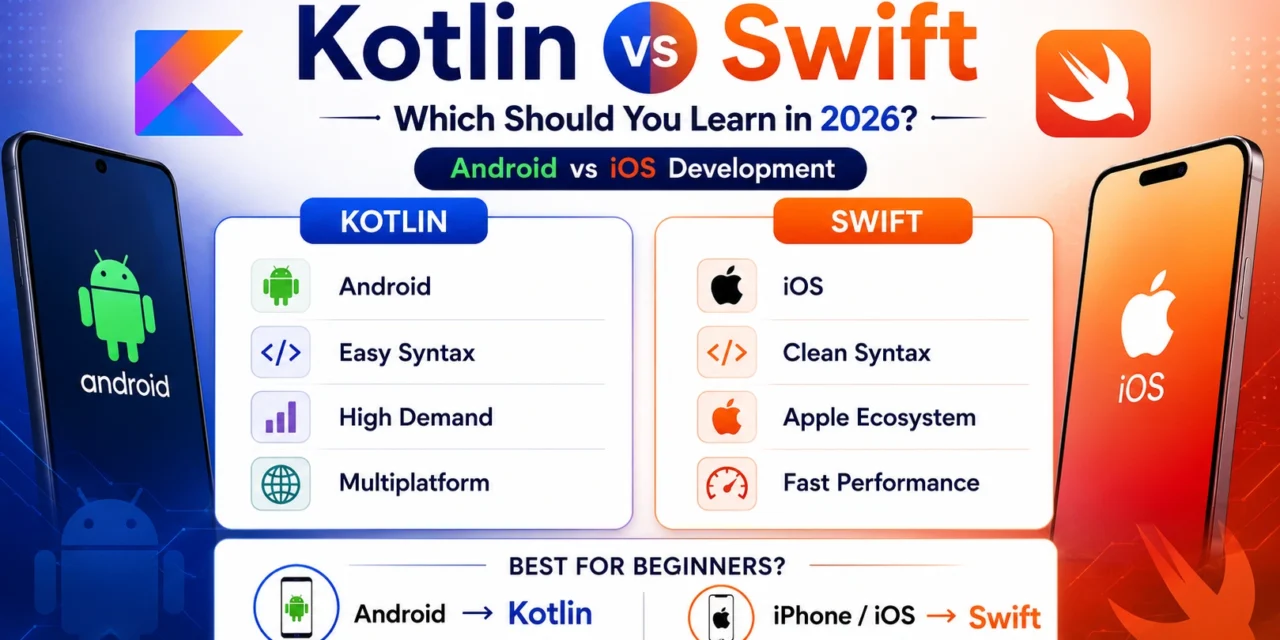
New mobile developers almost always face the same fork in the road early on: learn Kotlin for Android or Swift for iOS. Both languages are mature, well-documented, and genuinely pleasant to write compared to their predecessors, Java and Objective-C, so the decision usually comes down to market, ecosystem, and long-term goals rather than which language is objectively better on paper. This comparison breaks down how Kotlin and Swift actually differ in 2026, from day-to-day syntax to job market realities and cross-platform potential, to help new developers make a more informed first choice.
Syntax and Learning Curve
Both languages read cleanly compared to Java or Objective-C, with strong null-safety built in from the start. Kotlin’s syntax feels slightly closer to modern JavaScript or Python, while Swift leans more toward strict typing, which some beginners find easier to reason about early on.
Job Market and Demand
Swift developers tend to see strong demand concentrated in iOS-first companies and startups building for Apple’s ecosystem first. Kotlin developers benefit from Android’s larger global device footprint, especially in markets like India and Southeast Asia where Android dominates market share by a wide margin.
Ecosystem and Tooling
Xcode remains a fairly closed but polished environment for Swift development, tightly integrated with Apple’s own frameworks. Kotlin benefits from Android Studio’s maturity and, notably, Kotlin’s ability to be used outside mobile entirely through Kotlin Multiplatform and server-side projects.
Cross-Platform Potential
Kotlin Multiplatform has gained real traction for sharing business logic between Android, iOS, and even backend code, which gives Kotlin developers a broader skill set beyond just Android. Swift’s cross-platform story is comparatively limited, staying mostly within Apple’s own device ecosystem.
Which Should You Pick First
If you already own an iPhone and want to build apps for Apple’s ecosystem specifically, Swift is the more direct path. If you want broader device reach or interest in eventually working across platforms, Kotlin is generally the safer long-term investment.
A Note on Salaries and Career Longevity
Compensation for both Kotlin and Swift developers has stayed competitive globally, though the exact numbers vary heavily by region and company size rather than by language choice alone. Kotlin developers in markets with strong Android penetration, including much of Asia, tend to have a larger absolute pool of job openings, simply because more companies build for Android first in those regions. Swift developers, meanwhile, often see slightly higher average compensation in North America and parts of Europe, tied to the concentration of well-funded companies building premium, iOS-first products. Neither trend is fixed forever, and both can shift as device market share and company priorities change over the coming years, so treating either language as a permanently safer bet than the other would be overstating what the current data actually shows.
Neither language is going anywhere, and skills in one transfer conceptually to the other far more easily than either transfers from something like Java or Objective-C, since both languages share similar modern concepts around null safety, optionals, and concise syntax. The better strategy for most new developers is picking based on which platform they actually want to build for first, then adding the second language later once the fundamentals are solid and the first app is actually shipped. Trying to learn both at once tends to slow beginners down far more than it speeds them up, so resist the urge to split focus until you’re genuinely comfortable building something end to end in your first language.