
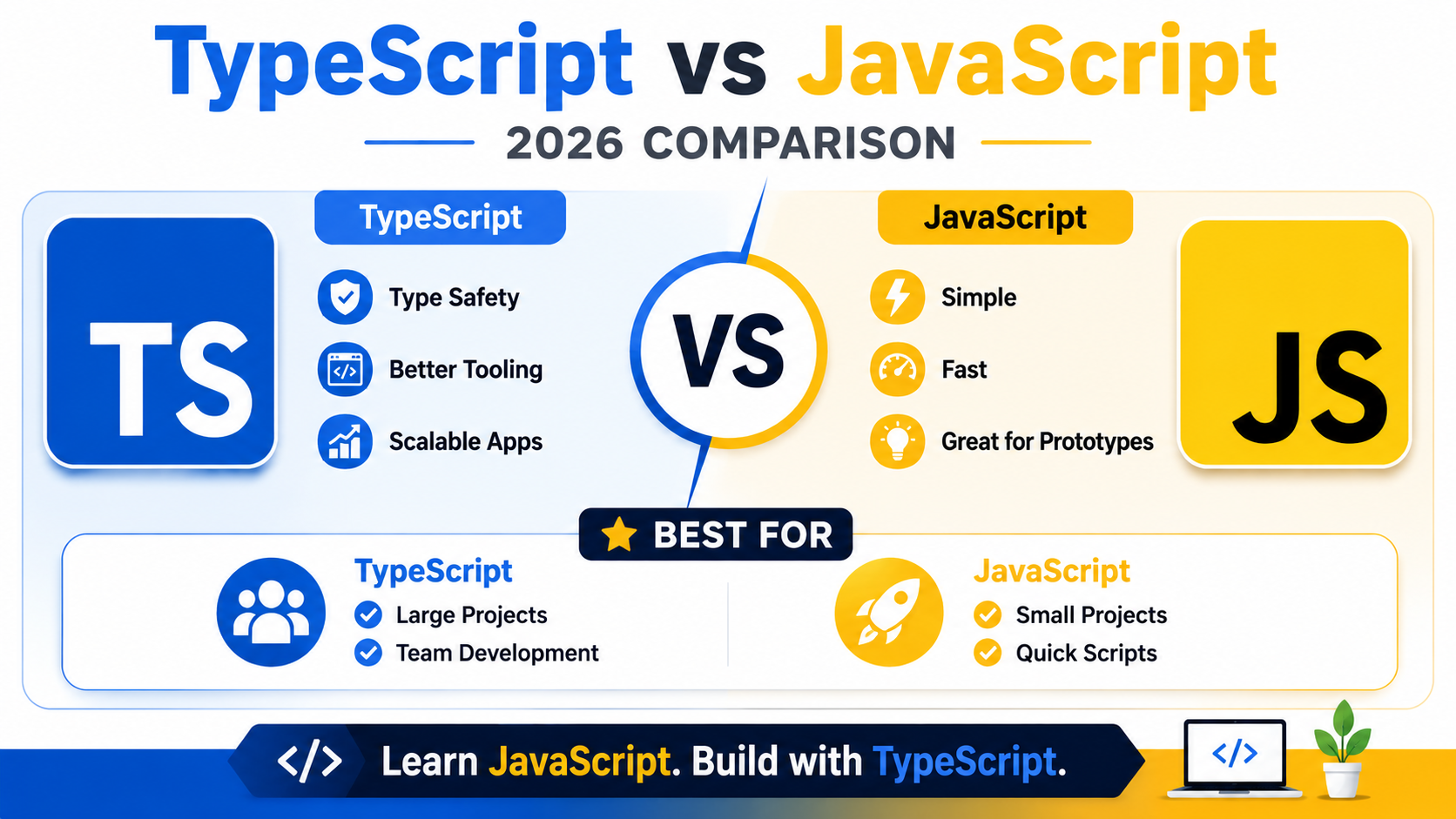
TypeScript has steadily moved from an optional enhancement to the default choice for many professional JavaScript teams, adding static typing that catches a genuine category of bugs before code ever runs, at the cost of some added complexity and a compilation step that plain JavaScript doesn’t require. By 2026, the question isn’t really whether TypeScript is valuable, that’s been fairly well settled by widespread industry adoption, but whether plain JavaScript still has a genuine place for certain projects and developers, or whether learning it in isolation has become a genuinely unnecessary detour from TypeScript from the very start.
Where TypeScript Wins
TypeScript’s static type checking catches genuine bugs, like passing the wrong data type to a function, before code ever runs, and its editor autocomplete and inline documentation support make working in a large, unfamiliar codebase noticeably easier than plain JavaScript allows.
Where Plain JavaScript Still Matters
Plain JavaScript remains genuinely relevant for small scripts, quick prototypes, and situations where the overhead of a build step and type annotations would slow down experimentation more than the type safety would actually help at that small scale.
The Learning Path Question
New developers increasingly debate whether to learn TypeScript from the very start or build genuine JavaScript fundamentals first, with a reasonable case existing for either approach depending on whether someone learns better with immediate structure or prefers understanding the underlying language unconstrained first.
What Most Teams Actually Do in Practice
The large majority of professional frontend and Node.js teams in 2026 default to TypeScript for anything beyond a small script, making genuine TypeScript fluency an increasingly practical job market expectation regardless of a developer’s personal language preference.
The practical reality is that nearly all JavaScript code, TypeScript included, ultimately compiles down to plain JavaScript that actually runs in a browser or on a server, meaning a genuine understanding of core JavaScript concepts, closures, prototypes, asynchronous behavior, remains valuable regardless of which syntax a developer writes in day to day. New developers are generally well served learning core JavaScript fundamentals concurrently with TypeScript rather than treating them as entirely sequential steps, since TypeScript’s type system sits on top of JavaScript rather than replacing the need to understand how the underlying language actually behaves at runtime. Experienced JavaScript developers without TypeScript experience should treat learning it as a genuinely worthwhile investment given current job market expectations, even if their personal preference still leans toward plain JavaScript for smaller personal projects. Building the same small project in both approaches tends to reveal these practical tradeoffs more clearly than any single article comparing them in the abstract. Reading a large, well-maintained open source TypeScript codebase is also a genuinely good way to see conventions and patterns that a tutorial alone rarely covers in enough depth.
TypeScript has genuinely earned its default status for professional team development given the real bugs it catches and the tooling benefits it provides, but plain JavaScript understanding remains the foundation everything else sits on top of regardless of which syntax ends up in the final codebase. Rather than treating this as a strict either-or choice, the most capable developers build genuine fluency in both, understanding JavaScript deeply while defaulting to TypeScript for anything beyond the smallest, most disposable script. That dual fluency also makes reading and contributing to other teams’ codebases considerably less intimidating.