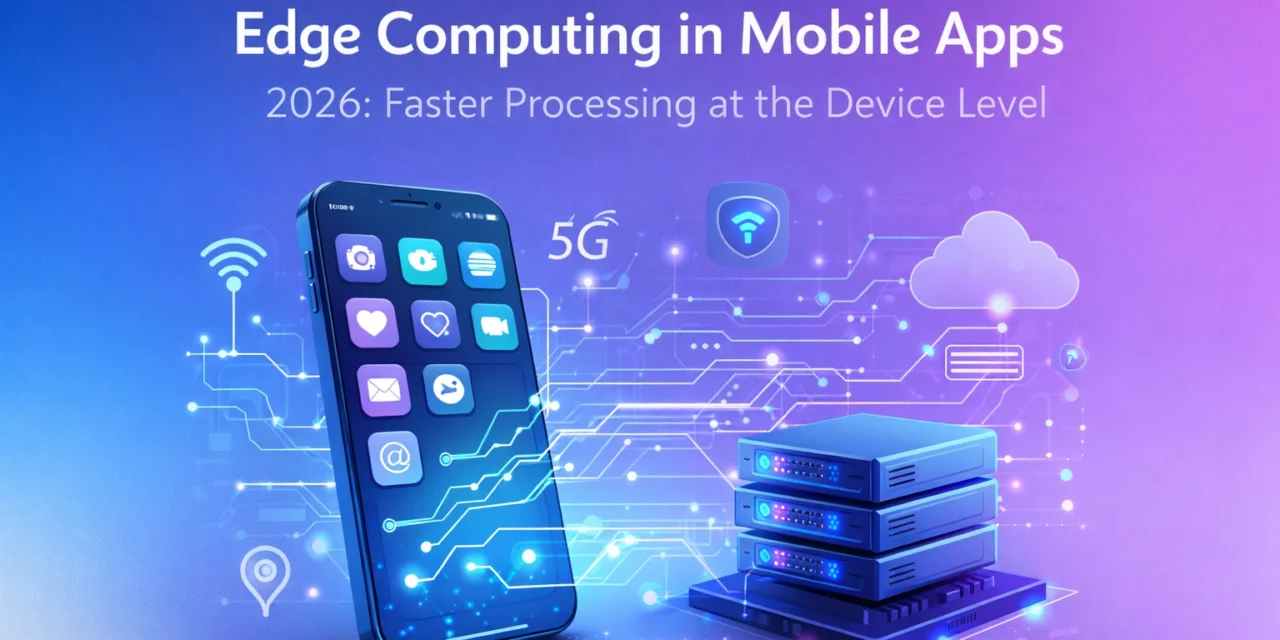
The mobile computing paradigm is experiencing a fundamental shift as processing power moves from distant cloud servers to the edge—directly on devices and nearby infrastructure. With the edge computing market projected to grow at a staggering 37.4% compound annual growth rate, reaching substantial valuations over the next decade, this architectural transformation is redefining what’s possible in mobile applications.
Understanding Edge Computing Fundamentals
Edge computing processes data where it’s generated rather than transmitting everything to centralized cloud servers. For mobile applications, this means leveraging smartphone computational power, nearby edge servers, or local infrastructure to handle data processing, analysis, and decision-making. The approach dramatically reduces latency, minimizes bandwidth consumption, and enhances privacy by keeping sensitive data local.
Traditional cloud-centric architectures send every request and data point to remote servers potentially thousands of miles away. Each round trip introduces latency—the delay between action and response—that accumulates into noticeable lag degrading user experiences. Video calls stutter, augmented reality overlays lag behind camera feeds, and real-time collaboration feels sluggish.
Edge computing eliminates these delays by processing locally. A smartphone analyzing a photo for object recognition doesn’t need to upload the image, wait for server processing, and download results. Instead, on-device neural networks identify objects in milliseconds, enabling instant responses that feel truly real-time.
The architectural benefits extend beyond speed. Bandwidth costs decrease substantially when applications process data locally rather than constantly streaming to cloud services. This proves particularly valuable in regions with expensive mobile data or limited connectivity. Edge approaches enable functionality continuing seamlessly even when internet connections drop, a critical capability for mission-critical applications.
The Technology Stack Enabling Edge
Modern smartphones contain remarkable computational capabilities rivaling computers from just years ago. Apple’s latest A-series chips and Qualcomm’s Snapdragon processors include dedicated neural engines processing machine learning workloads efficiently. These specialized components execute AI models on-device without draining batteries, enabling sophisticated functionality previously requiring cloud resources.
TensorFlow Lite and similar frameworks optimize machine learning models for mobile deployment, converting large cloud models into compact versions running efficiently on resource-constrained devices. These compressed models sacrifice minimal accuracy while dramatically reducing size and computational requirements.
WebAssembly brings near-native performance to web applications, enabling complex processing in browsers without plugins. Progressive web apps leverage WebAssembly for computationally intensive tasks like image processing, data analysis, and real-time communications—capabilities previously requiring native applications.
5G networks enhance edge computing through multi-access edge computing (MEC) architectures. Cellular providers deploy edge servers at base stations processing data locally before routing to cloud backends. This infrastructure provides cloud-like computational resources with edge-like latency, creating optimal balances for applications requiring more power than devices provide but less latency than distant clouds introduce.
Real-World Applications Transforming Industries
Augmented reality represents perhaps the most compelling edge computing use case. AR experiences overlay digital information on physical environments captured through device cameras. Success requires sub-50 millisecond latency between camera capture and display rendering—impossible with cloud round trips but achievable through on-device processing. Applications ranging from iPhone AR games to professional Android industrial tools leverage edge processing for smooth, immersive experiences.
Autonomous vehicles depend entirely on edge computing for safety-critical decisions. Self-driving cars cannot afford cloud latency when detecting obstacles, analyzing traffic conditions, or executing emergency maneuvers. Vehicle systems process sensor data locally, making split-second decisions ensuring passenger safety. Mobile apps controlling or monitoring autonomous vehicles similarly benefit from edge architectures ensuring responsiveness.
Healthcare applications process sensitive patient data locally, maintaining privacy while enabling real-time analysis. Wearable devices monitor vital signs, detect anomalies, and alert users to potential health issues without transmitting raw medical data to cloud servers. This edge-first approach addresses privacy regulations while providing life-saving functionality.
Retail applications use edge computing for instant visual search, real-time inventory checking, and seamless checkout experiences. Customers photograph products for instant information without waiting for cloud image analysis. Point-of-sale systems process transactions locally, remaining functional during internet outages that would cripple cloud-dependent systems.
Privacy and Security Advantages
Data minimization becomes practical when edge computing processes information locally. Applications extract insights from sensitive data without transmitting raw information to external servers. A health app might analyze step patterns to detect fall risk without uploading detailed movement data. A voice assistant could process commands on-device without sending recordings to cloud services.
This privacy-preserving architecture addresses growing consumer concerns about data collection and regulatory requirements including GDPR and CCPA. By demonstrating that sensitive data never leaves devices, applications build trust while achieving compliance more easily than cloud-centric alternatives.
Security benefits accompany privacy advantages. Reduced data transmission means fewer opportunities for interception during transit. Processing locally eliminates classes of attacks targeting cloud infrastructure or network communications. While edge devices face their own security challenges, the reduced attack surface and limited data exposure create meaningful security improvements.
Compliance with data sovereignty regulations becomes simpler when data processing occurs within specific geographic boundaries. Edge architectures enable applications to function globally while keeping user data within jurisdictional requirements without complex data routing or regional cloud deployments.
Performance Optimization Strategies
Efficient edge computing requires thoughtful optimization balancing functionality against resource constraints. Mobile devices have limited processing power, memory, and battery capacity compared to cloud servers. Applications must carefully manage these resources to deliver functionality without degrading device performance or draining batteries.
Model compression techniques reduce machine learning model sizes by 10-100x while maintaining acceptable accuracy. Quantization, pruning, and knowledge distillation create compact models suitable for mobile deployment. These optimized models execute faster, consume less memory, and require less power than full-sized versions.
Hybrid architectures intelligently distribute processing between edge and cloud based on computational requirements and connectivity conditions. Simple tasks process locally while complex analysis leverages cloud resources when available. This flexibility provides optimal user experiences across varying conditions without rigidly committing to pure edge or cloud approaches.
Caching strategies store frequently accessed data and precomputed results locally, eliminating redundant processing and network requests. Smart caching considers usage patterns, available storage, and data freshness requirements to optimize what stays local versus what requires fresh retrieval.
Progressive enhancement enables basic functionality offline while adding cloud-powered features when connectivity permits. Users accomplish core tasks without internet access while benefiting from enhanced capabilities like synchronized data, advanced analysis, or collaborative features when online.
Development Frameworks and Tools
Modern development frameworks simplify edge computing implementation. TensorFlow Lite enables deploying machine learning models on mobile devices with minimal code changes. Developers train models using full TensorFlow, then convert to Lite versions optimized for mobile deployment. The framework handles hardware acceleration, using device neural engines when available.
PyTorch Mobile provides similar capabilities for developers preferring PyTorch ecosystems. The framework supports model optimization, quantization, and mobile deployment with straightforward conversion processes. Cross-platform support ensures models work on both iOS and Android devices.
Core ML powers on-device machine learning for Apple platforms, integrating seamlessly with iOS development. The framework provides pre-trained models for common tasks while supporting custom model deployment. Optimization tools ensure models execute efficiently on Apple silicon.
ML Kit offers ready-to-use machine learning APIs for common tasks including text recognition, face detection, barcode scanning, and language translation. Google’s framework handles model management, updates, and execution, enabling developers to add sophisticated capabilities without machine learning expertise.
Bandwidth and Cost Reduction
Edge computing delivers substantial cost savings through reduced bandwidth consumption. Applications processing data locally avoid constant cloud communication, decreasing data transfer costs for both developers and users. This proves particularly significant at scale—companies serving millions of users save millions in bandwidth costs monthly.
Users benefit from reduced mobile data consumption, particularly valuable with metered data plans or expensive roaming. Applications functioning primarily through edge processing consume minimal data compared to cloud-centric alternatives, improving accessibility in regions with costly connectivity.
Infrastructure costs decrease as edge processing reduces cloud computational requirements. While cloud services remain necessary for synchronization, storage, and complex processing, offloading routine tasks to edge devices reduces server loads and associated costs.
Challenges and Considerations
Device fragmentation complicates edge computing deployment across diverse hardware. Applications must support processors with varying capabilities, memory configurations, and specialized accelerators. Testing across representative device ranges ensures consistent functionality, though optimizing for every combination proves impractical.
Battery consumption concerns arise from intensive edge processing. While avoiding network communication saves power, on-device computation consumes energy. Developers must balance computational efficiency against functionality, ensuring applications don’t drain batteries unacceptably.
Model update challenges emerge as deployed edge models require updating without application updates. Over-the-air model updates enable improvements without full app releases, but require infrastructure for model distribution, versioning, and rollback capabilities when updates cause issues.
Limited computational resources constrain edge capabilities compared to cloud servers. Complex analyses, massive datasets, or computationally intensive tasks may exceed device capabilities, requiring hybrid approaches or accepting functionality limitations.
The Edge-Cloud Continuum
Optimal architectures view edge and cloud as complementary rather than competing. The edge-cloud continuum recognizes that different workloads suit different processing locations. Real-time, latency-sensitive, or privacy-critical tasks run at the edge. Complex analysis, long-term storage, and resource-intensive processing leverage cloud capabilities.
Smart orchestration dynamically allocates workloads based on current conditions including device capability, battery status, connectivity quality, and computational requirements. This adaptive approach optimizes performance, cost, and user experience across varying scenarios.
Future Directions
Edge computing capabilities will expand dramatically as device processors gain power and efficiency. Future smartphones will handle workloads currently requiring substantial cloud resources, enabling entirely new application categories impossible today.
Distributed edge networks will emerge as multiple devices collaborate on tasks too complex for individual devices but not requiring cloud resources. Peer-to-peer processing enables novel applications in gaming, content creation, and collaborative work.
Standardization efforts will simplify cross-platform edge deployment. Current fragmentation requiring platform-specific implementations will give way to unified approaches working across ecosystems.
The convergence of edge computing, 5G networks, and advancing AI creates compound benefits exceeding what isolated technologies achieve. This synergy will drive innovations transforming mobile experiences fundamentally.
Conclusion
Edge computing represents more than optimization—it’s architectural evolution enabling experiences impossible through pure cloud approaches. Applications leveraging edge capabilities deliver responsiveness, privacy, and reliability that users increasingly expect and regulations increasingly require.
For mobile app developers and businesses, understanding and implementing edge computing now positions them advantageously as this architecture becomes standard rather than exceptional. The future of mobile computing isn’t cloud or edge—it’s intelligently combining both.
Explore more about emerging mobile technologies and development trends on AppsMirror.