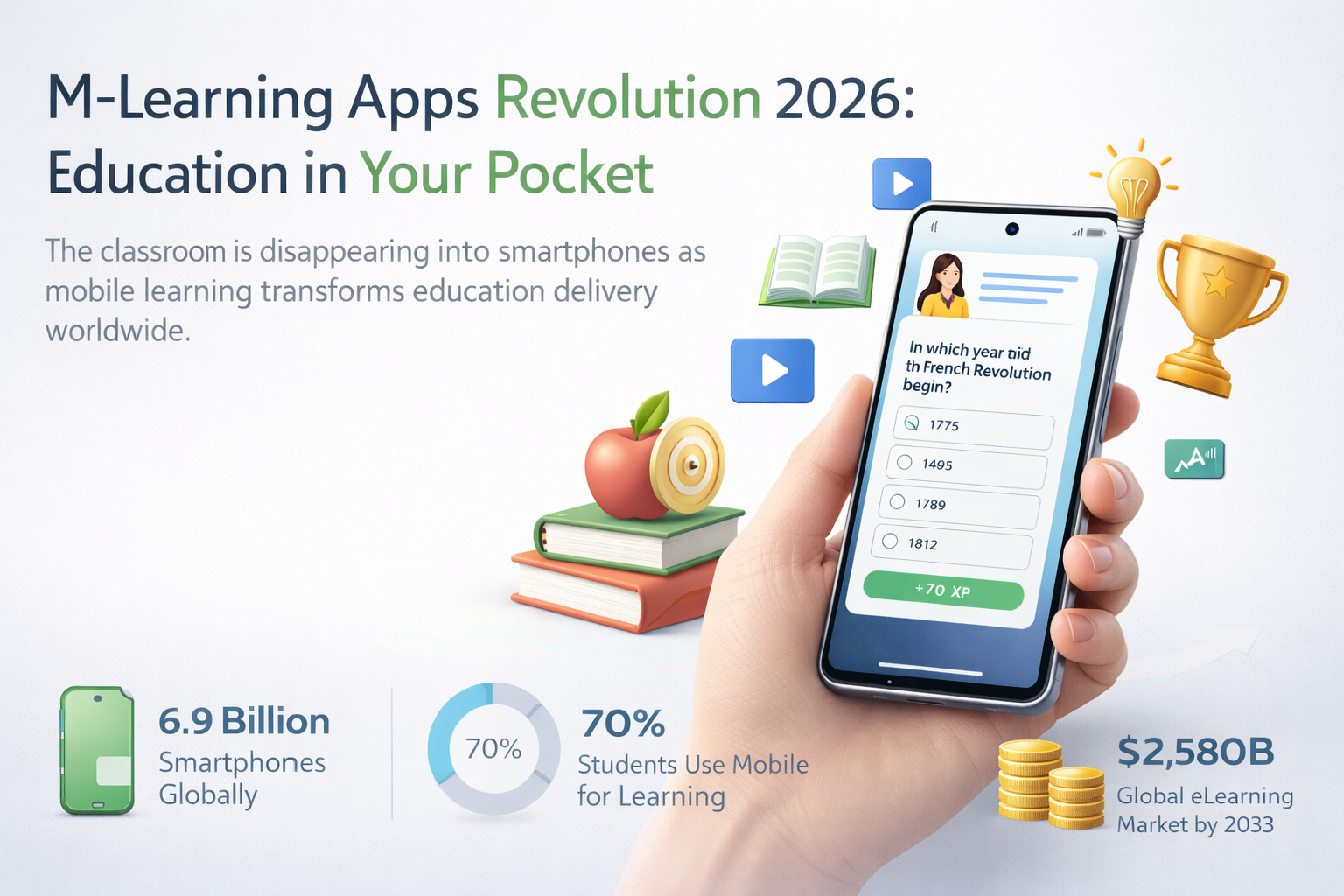
The classroom is disappearing into smartphones as mobile learning transforms education delivery worldwide. With the global eLearning market projected to reach $2,580.37 billion by 2033, growing at 17.54% annually, mobile learning applications are becoming the primary educational interface for billions of learners. This shift represents more than convenience—it’s democratizing access to knowledge in unprecedented ways.
The Mobile Learning Explosion
Mobile learning, or m-learning, enables educational content access anywhere, anytime through smartphones and tablets. Unlike traditional e-learning tied to computers, m-learning fits seamlessly into daily routines. Learners study during commutes, practice skills during breaks, and access resources whenever curiosity strikes. This flexibility transforms education from scheduled events into continuous processes woven throughout life.
The numbers validate m-learning’s impact. Over 70% of students use mobile devices for studying, while corporate training increasingly adopts mobile-first approaches recognizing that modern workers learn best through accessible, bite-sized content available on-demand. Educational institutions reporting mobile learning adoption see engagement improvements of 40-60% compared to traditional methods.
Several factors drive explosive m-learning growth. Smartphone penetration reached over 6.9 billion users globally, providing the hardware foundation for universal education access. Improved connectivity through 4G and 5G networks enables rich multimedia content streaming without frustrating delays. Touch interfaces and intuitive mobile operating systems lower technical barriers that previously limited educational technology adoption.
The COVID-19 pandemic accelerated m-learning adoption by necessity, but convenience and effectiveness sustain growth. Students and professionals who discovered mobile learning during lockdowns continue using it by choice, recognizing advantages over traditional approaches.
Microlearning and Content Delivery
Microlearning represents m-learning’s most distinctive pedagogical innovation. Rather than hour-long lectures or lengthy study sessions, microlearning delivers focused lessons consumable in 3-7 minutes. These bite-sized modules respect modern attention spans while leveraging cognitive science principles about optimal learning durations.
The approach proves remarkably effective. Corporate training using microlearning shows 17% better knowledge retention compared to traditional methods. Students report completing 80% more courses when content is chunked into brief lessons versus lengthy modules. The psychology is straightforward—smaller commitments feel achievable, reducing procrastination while creating completion momentum.
Content formats optimized for mobile consumption include short videos explaining concepts visually, interactive quizzes providing immediate feedback, flashcard-style review sessions, infographics condensing complex information, and audio lessons enabling hands-free learning. This multimedia variety accommodates different learning styles while maintaining engagement through format diversity.
Adaptive learning algorithms personalize content delivery based on individual progress and performance. If learners struggle with specific concepts, algorithms provide additional practice and alternative explanations. Advanced students receive accelerated paths avoiding redundant review. This customization creates optimal challenge levels maintaining engagement without causing frustration or boredom.
Gamification Driving Engagement
Gamification transforms learning into engaging experiences leveraging game mechanics that make education enjoyable rather than obligatory. Points systems reward completed lessons, practice sessions, and knowledge mastery. Leaderboards create friendly competition motivating learners to progress. Achievement badges provide tangible accomplishments marking milestones. Streak tracking encourages daily engagement through visible progress indicators.
Duolingo exemplifies effective gamification, making language learning feel like mobile gaming. Users earn virtual currency, compete with friends, maintain learning streaks, and unlock new content through progression. This approach helped Duolingo surpass 500 million users, demonstrating gamification’s power to sustain long-term engagement in educational contexts.
The psychological principles are well-established. Variable rewards create addictive engagement loops similar to social media. Progress visualization provides motivation through visible advancement. Social elements including friend challenges and community interaction transform solitary learning into shared experiences. These mechanics work because they tap into fundamental human motivations including achievement, competition, and social connection.
Critics argue gamification risks prioritizing engagement over learning quality, potentially creating superficial knowledge through point-chasing rather than deep understanding. Effective implementations balance entertaining mechanics with rigorous educational standards, using games to enhance rather than replace substantive learning.
Platform Comparison and Features
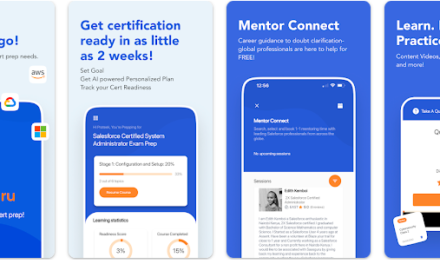
The m-learning landscape features diverse platforms serving different audiences and learning objectives. Coursera and edX provide mobile access to university-level courses from prestigious institutions. These apps bring higher education to learners worldwide, offering certificates and degrees through smartphone interfaces. The platforms excel at structured, comprehensive learning but require significant time commitments.
LinkedIn Learning targets professional development with business, technology, and creative skill courses. The mobile app enables career advancement through commute-time learning, integrating seamlessly with LinkedIn profiles to showcase acquired skills. The professional focus and practical application orientation suit working adults seeking advancement.
Khan Academy offers free educational content from elementary through college levels. The nonprofit’s mobile app provides quality education accessible to anyone with smartphones, regardless of financial circumstances. This democratization impact proves particularly significant in developing regions where mobile access far exceeds computer availability.
For younger learners, platforms like ABCmouse and Homer create age-appropriate educational games teaching reading, math, and critical thinking through engaging mobile experiences. These apps often prove more effective than traditional pre-school methods by adapting to individual learning paces.
Language learning dominates m-learning with Duolingo, Babbel, and Rosetta Stone offering comprehensive programs accessible entirely through mobile devices. The category’s success demonstrates m-learning’s particular suitability for practice-intensive skills benefiting from distributed daily sessions rather than concentrated weekly study.
Development on both iPhone and Android platforms ensures m-learning apps reach maximum audiences across device ecosystems.
Corporate Training Applications
Organizations increasingly deploy m-learning for employee training, recognizing that modern workers prefer learning through familiar smartphone interfaces. Mobile training proves particularly effective for distributed workforces, field employees, and roles where computer access is limited or impractical.
Compliance training leverages mobile delivery for mandatory content including safety procedures, harassment prevention, and regulatory requirements. Employees complete modules during downtime rather than scheduling dedicated training sessions, improving completion rates while minimizing productivity disruption.
Skill development apps provide just-in-time learning enabling employees to acquire capabilities immediately applicable to current projects. Rather than classroom training disconnected from practical application, mobile learning delivers relevant content when needed, improving retention and immediate utility.
Onboarding programs use mobile apps introducing new employees to company culture, policies, and procedures through self-paced learning. This approach reduces orientation time while ensuring consistent messaging across diverse hiring locations and schedules.
Sales enablement apps provide product information, competitive intelligence, and technique training accessible during customer interactions. Sales professionals refresh knowledge immediately before meetings, ensuring current information guides conversations.
Accessibility and Inclusion
M-learning dramatically improves educational accessibility for learners facing barriers in traditional systems. Geographic isolation no longer prevents quality education access as smartphone connectivity reaches remote areas lacking physical schools or universities. Students in rural regions access the same content as urban counterparts through mobile apps.
Physical disabilities that complicate traditional classroom attendance become less limiting with mobile learning. Students with mobility impairments learn from home. Visual impairments are accommodated through screen readers and audio content. Hearing impairments are addressed through visual learning materials and captioned videos.
Economic barriers decrease as mobile learning costs significantly less than traditional education. While quality smartphone ownership requirements remain barriers for the poorest populations, the cost gap between mobile and traditional education narrows dramatically. Many m-learning platforms offer free or low-cost options previously impossible.
Learning differences including dyslexia, ADHD, and autism spectrum disorders are better accommodated through personalized m-learning approaches. Students control pacing, review content multiple times without judgment, and use formats matching their learning preferences. This flexibility creates success where rigid traditional systems often fail.
Multilingual support expands access to non-native speakers. Quality m-learning apps provide content in numerous languages, enabling learning in preferred languages or supporting language acquisition through dual-language content.
Assessment and Certification
Mobile learning platforms employ diverse assessment methods measuring knowledge acquisition and skill development. Quiz-based assessments provide immediate feedback, reinforcing correct understanding while identifying knowledge gaps requiring additional study. These frequent low-stakes assessments reduce anxiety while promoting continuous evaluation.
Project-based assessments require learners to apply knowledge in practical scenarios, demonstrating competency beyond rote memorization. Mobile submission enables learners to complete projects using smartphone tools including cameras, recording apps, and productivity software.
Peer review systems leverage community expertise for evaluation, particularly effective in subjective areas like creative writing or design. Learners review classmates’ work based on rubrics, providing feedback while developing critical evaluation skills.
Certification through mobile platforms gains increasing recognition as employers acknowledge quality programs’ legitimacy. Platforms partner with universities and industry organizations to offer credentials with labor market value. These certifications often include verification mechanisms preventing fraud while enabling easy credential sharing.
Blockchain integration is emerging for immutable certification records preventing fraud and enabling instant verification. Learners control their educational credentials, sharing them directly with employers without intermediaries.
Technical Infrastructure Enabling M-Learning
Modern m-learning requires sophisticated technical infrastructure supporting rich content delivery, progress tracking, and personalized experiences. Content delivery networks ensure fast, reliable access globally by distributing materials across geographically distributed servers. Users access content from nearby servers, reducing latency regardless of physical location.
Offline functionality enables learning without constant connectivity, critical in regions with unreliable internet or for learners managing data costs. Apps download content during WiFi access for later offline use, synchronizing progress when connectivity returns.
Analytics platforms track detailed engagement metrics including completion rates, time-on-task, quiz performance, and content interactions. Educators and administrators use these insights to identify struggling learners, optimize content, and demonstrate program effectiveness.
Adaptive algorithms process performance data to personalize learning paths. These systems identify knowledge gaps, recommend appropriate content, and adjust difficulty levels automatically. The result is individualized education at scale impossible through human instruction alone.
Integration APIs connect m-learning platforms with existing educational technology infrastructure including student information systems, learning management systems, and assessment platforms. This interoperability enables m-learning as component in comprehensive educational ecosystems rather than isolated solution.
Content Creation and Development
Effective m-learning requires content specifically designed for mobile consumption rather than repurposed desktop materials. Mobile-first design principles prioritize touch interactions, vertical scrolling, and thumb-friendly navigation. Text remains readable without zooming, videos play in portrait orientation, and interactions work smoothly with finger taps.
Multimedia integration enhances learning through varied formats preventing monotony. Short explanatory videos, interactive simulations, audio narration, and animated graphics create engaging multi-sensory experiences. The variety also accommodates different learning preferences, improving outcomes across diverse learner populations.
Content should be modular, enabling flexible consumption patterns. Learners might complete one module today, three tomorrow, and none the next day based on available time and energy. Modular design prevents abandoned lengthy courses that feel overwhelming.
Performance optimization ensures smooth experiences even on budget devices and slower networks. Compressed assets, efficient code, and progressive loading maintain usability across varying device capabilities and network conditions.
Challenges and Limitations
Screen size constraints limit certain content types poorly suited to small displays. Complex diagrams, detailed spreadsheets, or extensive text become difficult on smartphone screens. Effective m-learning acknowledges these limitations, providing such content in formats suited to mobile viewing or recommending tablet/desktop access when appropriate.
Distraction potential affects mobile learning as devices deliver constant notifications and entertainment temptations. Learners must exercise discipline resisting interruptions, or use focus tools limiting distracting apps during study sessions.
Quality control varies dramatically across m-learning platforms. While established providers maintain rigorous standards, the low barriers to m-learning app creation mean many substandard offerings exist. Learners must evaluate platform credibility, content quality, and learning outcome effectiveness.
Digital divide issues persist as m-learning assumes smartphone access and data connectivity. While mobile penetration is high globally, the poorest populations still lack access. Even smartphone owners face data cost constraints limiting content consumption.
The Future of M-Learning
Artificial intelligence will increasingly personalize learning experiences beyond what current algorithms achieve. AI tutors will provide conversational guidance, answer questions in natural language, and adapt teaching approaches based on subtle engagement signals.
Augmented reality integration will enable immersive learning experiences impossible through traditional content. Students will explore historical sites, manipulate 3D molecular models, and practice skills in simulated environments—all through smartphone screens.
Social learning features will expand, creating vibrant learning communities within mobile apps. Learners will collaborate on projects, discuss concepts, and teach each other through peer interaction.
The convergence of m-learning with wearable devices will enable even more seamless learning integration into daily life. Smart watches will deliver quick lessons and practice prompts, while AR glasses will provide contextual learning based on what users are seeing and doing.
Conclusion
M-learning represents more than technological innovation—it’s fundamental transformation in how humans access knowledge and develop skills. The combination of universal smartphone access, sophisticated learning science, and engaging content delivery is democratizing education in unprecedented ways.
As we progress through 2026, m-learning will continue evolving from supplementary educational tool to primary learning interface for billions worldwide. Those who embrace mobile-first learning approaches—whether as developers, educators, or learners—position themselves advantageously in an increasingly knowledge-driven world.
Discover more educational technology trends and mobile innovations on AppsMirror.