
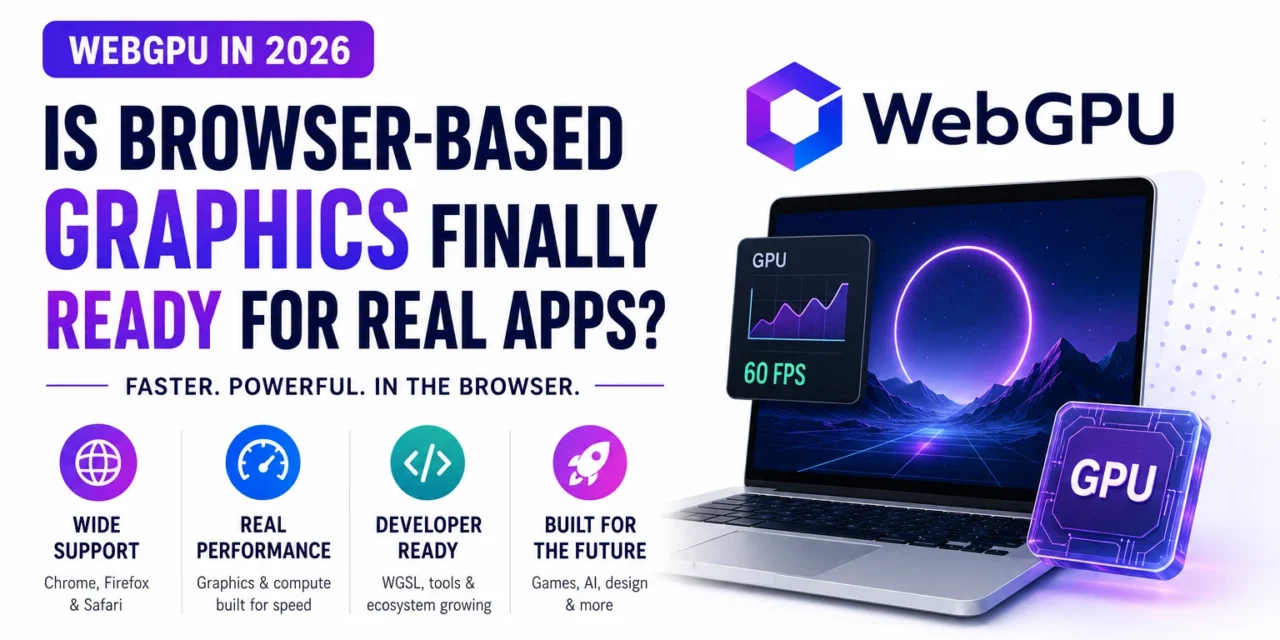
WebGPU has been discussed as the future of browser-based graphics for years now, promising to give web developers direct, low-level access to a device’s GPU in a way that the older WebGL standard never quite managed. After a long and somewhat bumpy rollout across different browsers, 2026 finally feels like the year where the conversation has shifted from cautious optimism to genuine production use. Games, data visualization tools, machine learning inference running client-side, and even professional creative applications are starting to ship real features built on WebGPU rather than treating it as an experimental flag hidden behind browser settings. This piece takes stock of where WebGPU actually stands today, looking at browser support, real performance gains, and the practical tradeoffs developers are running into as they adopt it in production.
Browser Support Has Finally Caught Up
For a long time, WebGPU adoption was held back by inconsistent support across major browsers, with Chrome leading the way while Safari and Firefox lagged noticeably behind in both timeline and feature completeness. That gap has narrowed substantially heading into 2026, with all three major browser engines now shipping WebGPU support by default rather than behind an experimental flag. Mobile browser support has also improved meaningfully, which matters enormously for any web app hoping to reach users on phones rather than assuming a desktop-class GPU. There are still edge-case feature differences between implementations, particularly around some of the more advanced compute shader capabilities, but the days of WebGPU being effectively unusable outside of Chrome are largely behind us.
Real Performance Gains in Production
The performance story has genuinely delivered on much of WebGPU’s early promise, particularly for compute-heavy workloads that WebGL was never well suited to handle. Developers running client-side machine learning inference, for example running a small language model or image classification model directly in the browser, report substantial speedups compared to WebGL-based approaches, since WebGPU’s compute shader support maps much more naturally onto these workloads. Graphics-heavy applications like browser-based 3D design tools and games have also seen frame rate improvements, particularly in scenes with complex lighting or large numbers of draw calls, where WebGPU’s more modern API design reduces overhead compared to WebGL’s older, more restrictive model.
Where the Rough Edges Still Show
Despite the real progress, WebGPU adoption in 2026 is not entirely friction-free. Debugging tooling, while improved, still lags noticeably behind the mature tooling available for native GPU development, making it harder to diagnose performance issues or shader bugs compared to working directly with something like Vulkan or Metal. Shader authoring in WebGPU’s shading language, WGSL, has a learning curve for developers coming from GLSL backgrounds, and while conversion tools exist, hand-tuning performance-critical shaders still often requires learning WGSL properly rather than relying purely on automated translation. Battery consumption on mobile devices for sustained WebGPU workloads also remains a real consideration, since heavy compute or rendering workloads can drain a phone’s battery meaningfully faster than lighter-weight rendering approaches.
Who Should Actually Adopt It Now
For teams building graphics-intensive or compute-intensive web applications, whether that’s a data visualization platform handling large datasets, a browser-based creative tool, or a client-side AI feature, 2026 is a reasonable time to commit to WebGPU as the primary rendering or compute path rather than treating it as a progressive enhancement layered on top of WebGL. Teams building simpler web apps with modest graphics needs likely still don’t need to rush, since the complexity WebGPU introduces isn’t justified without a workload that genuinely benefits from its lower-level GPU access. A hybrid approach, using WebGPU where available and falling back to WebGL for the small remaining slice of unsupported browsers, remains the most pragmatic path for applications that need to support the widest possible audience today.
Looking back at the full arc of coverage this year, WebGPU has moved from a promising but frustrating experimental technology to something genuinely viable for production use in the right context. The remaining gaps are less about fundamental capability and more about tooling maturity and the learning curve of a genuinely new shader language, both of which tend to improve steadily as adoption grows and more resources and examples become available to developers. It’s a good reminder that browser platform capabilities often take years longer to reach practical maturity than their initial announcement suggests, and WebGPU’s journey has followed that same familiar pattern.
Conclusion
Browser-based graphics have taken a real step forward in 2026, and WebGPU deserves genuine credit for finally delivering on years of promised low-level GPU access inside the browser. It isn’t the right fit for every web app, and the tooling still has room to mature, but for the graphics and compute-heavy use cases it was designed for, WebGPU has clearly crossed the line from experimental curiosity to production-ready technology this year.