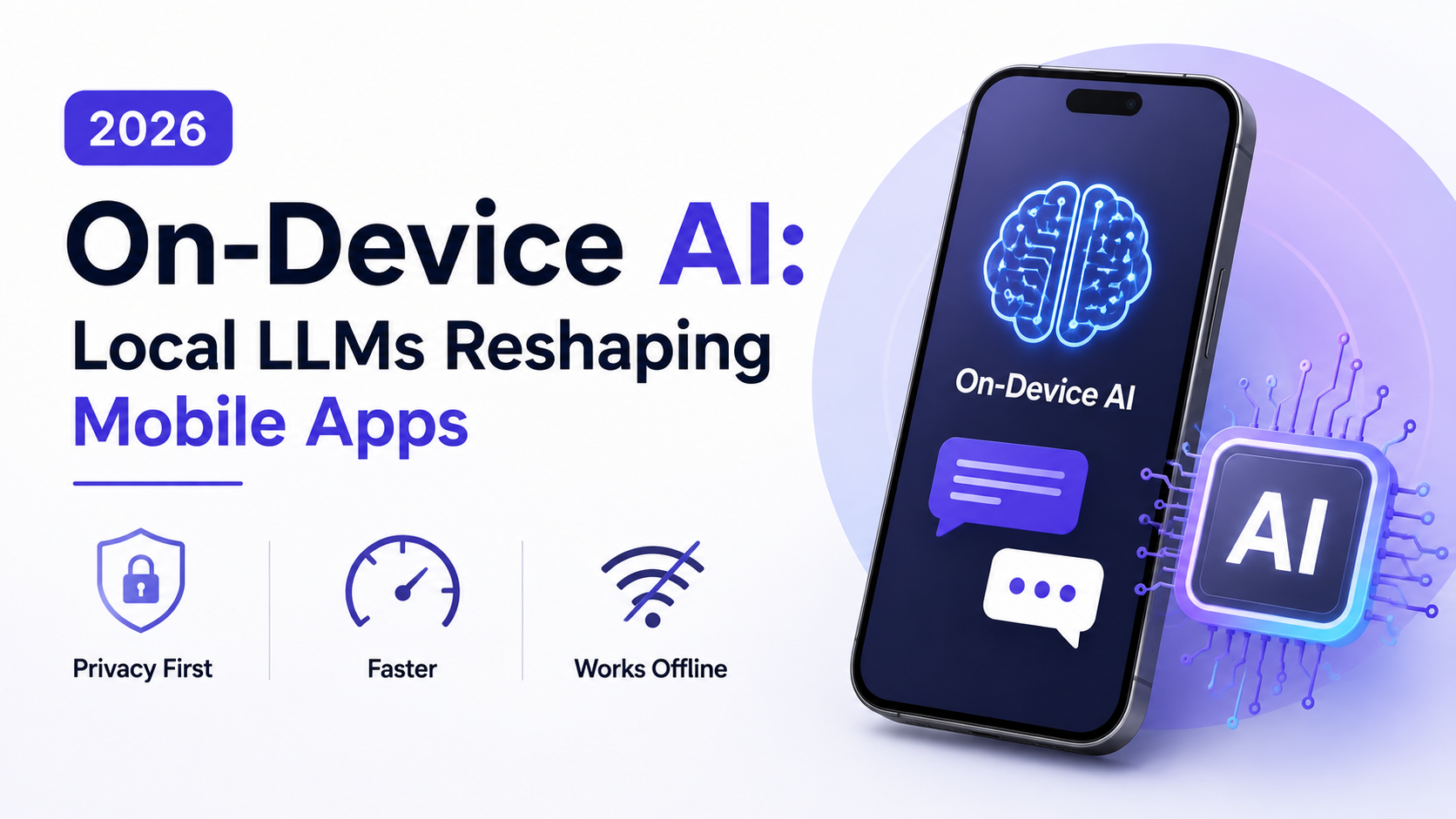
For the past several years, adding an AI feature to a mobile app has almost always meant the same basic architecture: capture user input, send it to a cloud API, wait for a response, and hope the network holds up. On-device AI models have started to genuinely challenge that default in 2026, with both Apple’s on-device foundation models and Google’s Gemini Nano now capable enough to handle a meaningful slice of tasks entirely on the phone itself, no network round trip required. This shift isn’t just a performance optimization; it’s changing real architectural decisions about what data an app needs to send off-device at all, and it’s opening up AI features in offline and privacy-sensitive contexts that simply weren’t practical before. Here’s a look at where on-device AI actually stands for mobile developers this year.
What’s Actually Running Locally Now
Apple’s on-device foundation model, accessible to third-party developers through its Foundation Models framework, handles tasks like text summarization, tone adjustment, and structured data extraction entirely on-device on recent iPhone hardware, with no API cost and no network dependency. Google’s Gemini Nano, built into Android’s ML Kit GenAI APIs, covers similar ground on the Android side, running on-device for tasks like summarization and rewriting on supported Pixel and select flagship devices. Both are still meaningfully smaller and less capable than their full cloud counterparts, and neither is a drop-in replacement for tasks requiring broad world knowledge or complex multi-step reasoning, but for narrow, well-defined tasks they’ve become genuinely production-viable in a way they weren’t even a year or two ago.
The Architectural Tradeoffs
Moving an AI feature on-device eliminates per-request API costs entirely and removes network latency from the interaction, which matters enormously for features that need to feel instant, like real-time text suggestions or live transcription cleanup, rather than tolerating a multi-second cloud round trip. It also means sensitive user data, personal messages, health information, financial details, never has to leave the device to power an AI feature, which meaningfully simplifies privacy and compliance conversations for apps handling that kind of information. The tradeoff is real capability limits: on-device models handle narrow, well-scoped tasks well but struggle with the kind of broad, open-ended reasoning that cloud models still handle far more reliably, so most production apps in 2026 are landing on a hybrid approach rather than picking one or the other exclusively.
Hybrid Architecture Is the Practical Default
The pattern that’s actually emerged across most serious 2026 app architectures isn’t a full replacement of cloud AI, it’s routing: simple, narrow, latency-sensitive tasks go to the on-device model first, and anything requiring deeper reasoning, broader context, or capability the local model doesn’t reliably handle falls back to a cloud API call. This routing logic adds real engineering complexity that wasn’t necessary in a cloud-only architecture, since a team now needs to maintain and test two different model behaviors and decide, sometimes dynamically based on device capability, which path a given request should take. Several third-party SDKs have emerged specifically to abstract this routing decision away from app developers, though most teams building AI-heavy features are still writing this logic by hand to maintain tight control over exactly which requests go where.
What This Means for Smaller Development Teams
For smaller teams and independent developers, on-device AI has genuinely lowered the barrier to shipping AI features that would have been cost-prohibitive at scale under a pure cloud-API pricing model, since there’s no per-request cost once a feature runs locally. The tradeoff is a narrower window of what’s actually achievable without a cloud fallback, and teams need to be honest during the design phase about which specific tasks the on-device models can reliably handle rather than assuming general AI capability. Device fragmentation adds another real constraint: on-device model availability still varies meaningfully across the installed base, since older or lower-end devices frequently lack the hardware to run these models locally at all, which means any on-device feature still needs a coherent fallback experience for a meaningful chunk of users.
Looking at where this technology actually stands today versus the more sweeping promises made when on-device AI was first announced, the honest assessment is that it’s genuinely useful for a real but still fairly narrow set of tasks, not a wholesale replacement for cloud-based AI features. The teams getting the most value from it in 2026 are the ones treating it as a targeted latency and privacy optimization for specific, well-scoped features, rather than trying to force broader AI functionality onto a model that isn’t built to handle it. As on-device model capability continues to improve with each hardware generation, expect the boundary of what’s practical to run locally to keep shifting outward, but the fundamental hybrid architecture pattern, route narrow tasks locally and fall back to the cloud for everything else, looks likely to remain the practical default for the foreseeable future rather than a temporary stopgap.
Conclusion
On-device AI has moved from an interesting hardware demo to a genuinely production-relevant architectural decision for mobile developers in 2026, even if it hasn’t replaced cloud AI the way some early framing suggested it eventually might. For teams building AI features today, the practical takeaway is straightforward: treat on-device models as a targeted tool for latency-sensitive or privacy-sensitive narrow tasks, build a coherent cloud fallback for everything else, and expect the line between the two to keep moving as on-device hardware and models continue to mature.