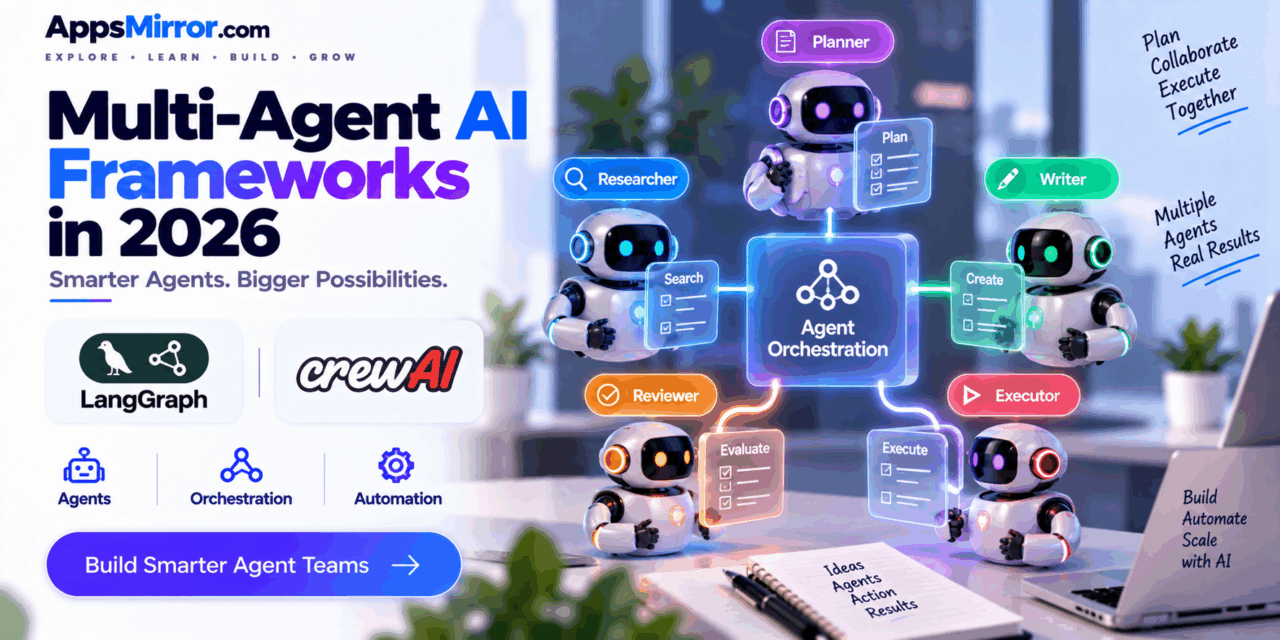
Building a single reliable AI agent remains a genuinely hard engineering problem, and multi-agent orchestration frameworks raise the stakes further by attempting to coordinate several specialized agents working together on a shared task, a planner agent delegating to a researcher agent, which hands off to a writer agent, for instance. Frameworks like LangGraph and CrewAI have emerged specifically to structure this coordination, but by 2026 enough teams have attempted production multi-agent systems that a genuinely honest picture has emerged of what actually works and where the added coordination complexity introduces more problems than it solves. Here’s an honest look at where multi-agent orchestration actually stands this year.
What These Frameworks Actually Provide
LangGraph, built by the team behind LangChain, models multi-agent workflows as an explicit graph structure, where each node represents an agent or a processing step and edges define exactly how control and data flow between them, giving developers precise, deterministic control over how a complex task gets decomposed and executed. CrewAI takes a somewhat higher-level, role-based approach, letting developers define agents with specific roles and goals, a researcher, a writer, a reviewer, and delegate a task to that crew, with the framework handling more of the coordination logic implicitly rather than requiring an explicit graph definition. Both frameworks fundamentally solve the same core problem, giving structure to what would otherwise be an unmanageable tangle of agent-to-agent handoffs and shared state, but they trade off explicit control against ease of initial setup in genuinely different ways.
Where Multi-Agent Systems Genuinely Add Value
The clearest production value shows up in tasks that naturally decompose into genuinely distinct specialized roles requiring different tools, context, or reasoning approaches, a research task that benefits from a dedicated search-and-summarize agent feeding into a separate synthesis-and-writing agent, for example, rather than asking a single agent to context-switch between fundamentally different modes of work within one continuous reasoning chain. Specialization also helps with prompt and context management, since a narrowly scoped agent with a focused system prompt and limited tool access tends to behave more predictably than one enormous, do-everything agent juggling a sprawling set of tools and instructions simultaneously. Teams reporting genuine production success with multi-agent systems consistently describe workflows where the task decomposition itself was already fairly natural and well-understood, rather than forcing an artificial multi-agent structure onto a task that a single well-designed agent could have handled directly.
Where the Coordination Overhead Genuinely Bites
The most consistently cited problem is compounding unreliability: if each individual agent in a chain has, say, a 90 percent success rate at its specific sub-task, a five-agent pipeline’s overall success rate drops considerably faster than intuition suggests, since errors compound multiplicatively across the chain rather than averaging out. Debugging a multi-agent failure is also genuinely harder than debugging a single agent, since a wrong final output could stem from any agent in the chain, or from a miscommunication in how one agent’s output got interpreted by the next, and tracing that root cause requires considerably more sophisticated observability tooling than a single-agent system needs. Cost and latency compound too, since a multi-agent pipeline typically makes several times more model calls than a single well-designed agent handling the same task, a real consideration for production systems operating at meaningful volume rather than isolated demo runs.
Should Your Team Actually Adopt This Now
For genuinely complex tasks with a natural, well-understood decomposition into specialized sub-tasks, where each individual agent’s scope stays narrow and its success rate can be measured and maintained reliably, multi-agent orchestration frameworks like LangGraph or CrewAI remain a legitimate and increasingly well-tooled investment in 2026. Teams considering a multi-agent structure primarily because it sounds more sophisticated, rather than because a task’s natural decomposition genuinely demands it, should think carefully first about whether a single, well-designed agent with a focused toolset might actually deliver more reliable results with considerably less coordination overhead and compounding error risk. As with most emerging agentic patterns, the right question isn’t whether multi-agent orchestration is impressive engineering, it clearly can be, but whether a specific task’s structure genuinely benefits from the added specialization enough to justify the real reliability and debugging costs that coordination overhead introduces.
Looking at where multi-agent orchestration actually stands after genuine production attempts beyond the demo stage, the honest assessment mirrors the broader pattern seen across agentic AI more generally this year: real, measurable value for the specific category of tasks with a genuinely natural specialized decomposition, alongside real, underappreciated coordination overhead for tasks forced into a multi-agent structure without that natural fit. The teams getting genuine value from LangGraph or CrewAI are treating multi-agent architecture as a deliberate response to a task’s actual structure, not a default sophistication upgrade applied to every agentic project regardless of fit. As observability and debugging tooling for multi-agent systems continues to mature through 2026, expect the practical threshold for adopting this pattern to keep shifting, but the fundamental compounding-error math means single, well-scoped agents will likely remain the simpler, more reliable default for a meaningful share of tasks.
Conclusion
Multi-agent orchestration frameworks have made genuine, tooling-backed progress in 2026 for the specific category of tasks with a naturally specialized decomposition, even as the coordination overhead and compounding error risk remain real for tasks forced into the pattern without that natural fit. For teams evaluating LangGraph, CrewAI, or similar frameworks today, the honest starting question isn’t which framework to pick, it’s whether a specific task genuinely needs multiple specialized agents at all, or whether a single, well-designed agent would deliver more reliable results with considerably less engineering complexity.