
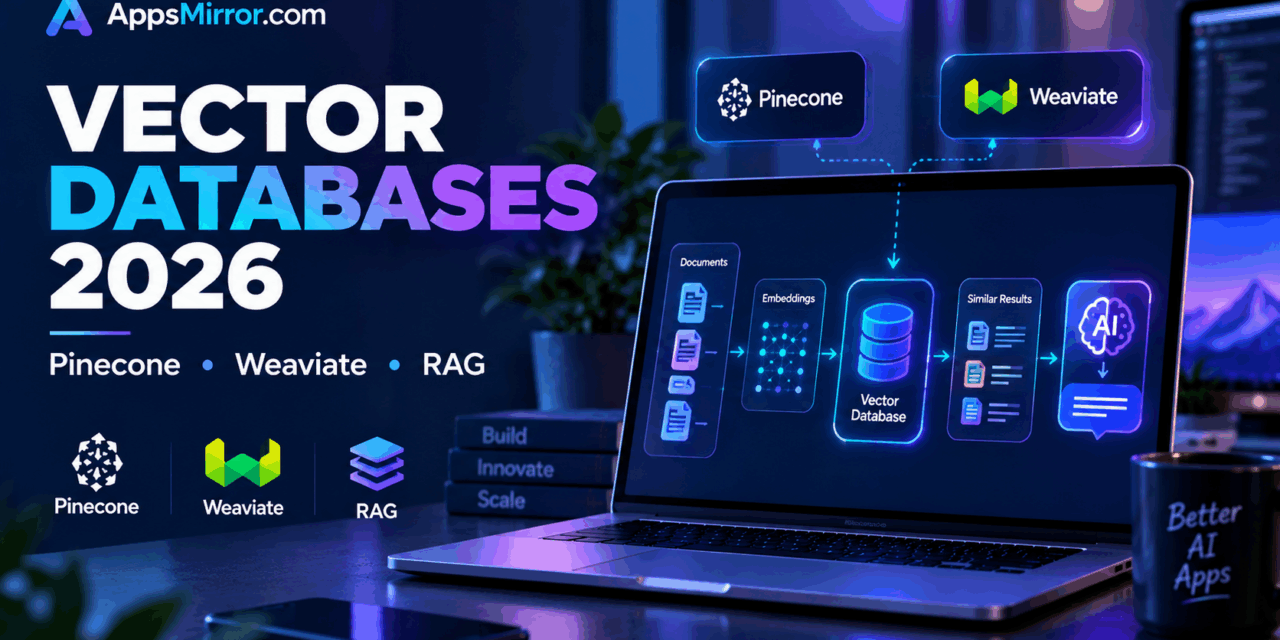
Vector databases exploded into mainstream developer awareness alongside the broader retrieval-augmented generation, or RAG, wave, storing the numerical embeddings that represent a document’s semantic meaning and letting an application quickly find conceptually similar content rather than only exact keyword matches. By 2026, the landscape has shifted meaningfully from its earlier moment: nearly every major general-purpose database, PostgreSQL, MongoDB, Elasticsearch, has bolted on genuinely capable vector search extensions, raising an honest question worth examining directly, does dedicated vector database infrastructure still make sense, or has the underlying capability simply become a commodity feature bundled into whatever database a team is already running?
What Dedicated Vector Databases Still Do Better
Purpose-built vector databases like Pinecone and Weaviate remain genuinely ahead on raw search performance at large scale, using specialized indexing algorithms specifically optimized for high-dimensional similarity search that a general-purpose database’s bolted-on extension typically can’t match at meaningfully large data volumes. Pinecone’s fully managed, serverless architecture removes essentially all infrastructure management burden, automatically scaling storage and query capacity without requiring a team to provision or tune underlying compute resources themselves. Weaviate distinguishes itself with genuinely strong hybrid search, combining traditional keyword search with vector similarity in a single unified query, and its open-source availability gives teams a credible self-hosted path that pure managed services like Pinecone don’t offer.
Where the Bolted-On Alternative Genuinely Wins
For teams already running PostgreSQL with the pgvector extension, or MongoDB with its native vector search capability, adding vector search to an existing database eliminates the real operational overhead of running, securing, and keeping data synchronized across an entirely separate specialized system. This matters enormously for the common RAG pattern where vector embeddings need to stay tightly consistent with a rapidly changing set of source documents already living in a primary database, since a separate vector database introduces a genuine data synchronization problem that a bolted-on extension avoids by definition. For moderate-scale applications where the specialized performance edge of a dedicated vector database doesn’t yet meaningfully matter, the operational simplicity of one fewer system to run and keep synchronized often outweighs the raw performance advantage a purpose-built alternative offers.
The Honest Scale Threshold
The practical pattern that’s emerged across production RAG deployments in 2026 is a genuine scale-dependent tradeoff: applications with millions of vectors and demanding, low-latency query requirements consistently benefit from a dedicated vector database’s specialized indexing and query performance, while applications with a more modest vector count, tens of thousands to a few hundred thousand, rarely hit the performance ceiling where a bolted-on extension in an existing database becomes a genuine bottleneck. Teams frequently overestimate their actual scale needs early in a project, adopting a dedicated vector database before their data volume genuinely justifies the added operational complexity, only to realize months later that pgvector or a similar bolted-on extension would have handled their actual production load perfectly well. The honest advice from teams who’ve gone through this cycle consistently is to start with the simpler, bolted-on option and migrate to dedicated vector infrastructure only once genuine performance data demonstrates the need, rather than provisioning for a scale that may never actually materialize.
Should Your Team Actually Use One Now
For genuinely large-scale RAG applications with millions of vectors, demanding sub-second query latency requirements, or complex hybrid search needs combining multiple retrieval strategies, a dedicated vector database like Pinecone or Weaviate remains a legitimate, well-justified infrastructure investment in 2026. Teams building a moderate-scale RAG feature on top of an already-established PostgreSQL or MongoDB deployment are very likely better served starting with that database’s native vector extension rather than introducing an entirely separate specialized system, at least until real production data demonstrates a genuine performance or scale need that the bolted-on option can’t satisfy. As with most infrastructure decisions covered this year, the right question isn’t whether dedicated vector databases are impressive technology, they clearly are, but whether a specific application’s actual scale and query demands genuinely justify the added operational complexity of running a separate specialized system.
Looking at where vector database infrastructure actually stands in 2026, the honest assessment is that the category has matured from an urgent, must-adopt trend into a genuine, scale-dependent architectural decision rather than a default requirement for any application touching embeddings or RAG. The teams making the smartest infrastructure choices are starting with whatever bolted-on vector capability their existing primary database already offers, and migrating to dedicated infrastructure like Pinecone or Weaviate only once real production data demonstrates the specific performance or scale need that justifies the added operational complexity. As bolted-on vector extensions in mainstream databases continue improving their own performance and feature depth, expect the practical threshold for needing dedicated vector infrastructure to keep climbing higher, without the specialized platforms disappearing entirely for genuinely large-scale, latency-sensitive use cases.
Conclusion
Vector databases have made real, valuable progress in 2026, and for genuinely large-scale, performance-demanding RAG applications, dedicated platforms like Pinecone and Weaviate remain a well-justified infrastructure choice. For the considerably larger share of applications operating at moderate scale, though, the honest advice from teams who’ve lived through this decision consistently points the same direction: start with the vector extension already available in whatever database is already in production, and only introduce dedicated vector infrastructure once real usage data demonstrates the genuine need.