WebAssembly, or WASM, has spent years carrying the promise of near-native performance running inside a browser or lightweight runtime, portable across platforms without the overhead of a full native app rebuild for each operating system. On the web, that promise has largely delivered, with WASM now powering everything from CAD software to video editors running directly in a browser tab. On mobile specifically, the story in 2026 is more nuanced: real progress has been made, but WASM still isn’t displacing native development the way some of its earliest advocates predicted. This piece takes stock of where WebAssembly on mobile actually stands today, what it’s genuinely good for, and where native development still clearly wins.
Where WASM Genuinely Shines on Mobile
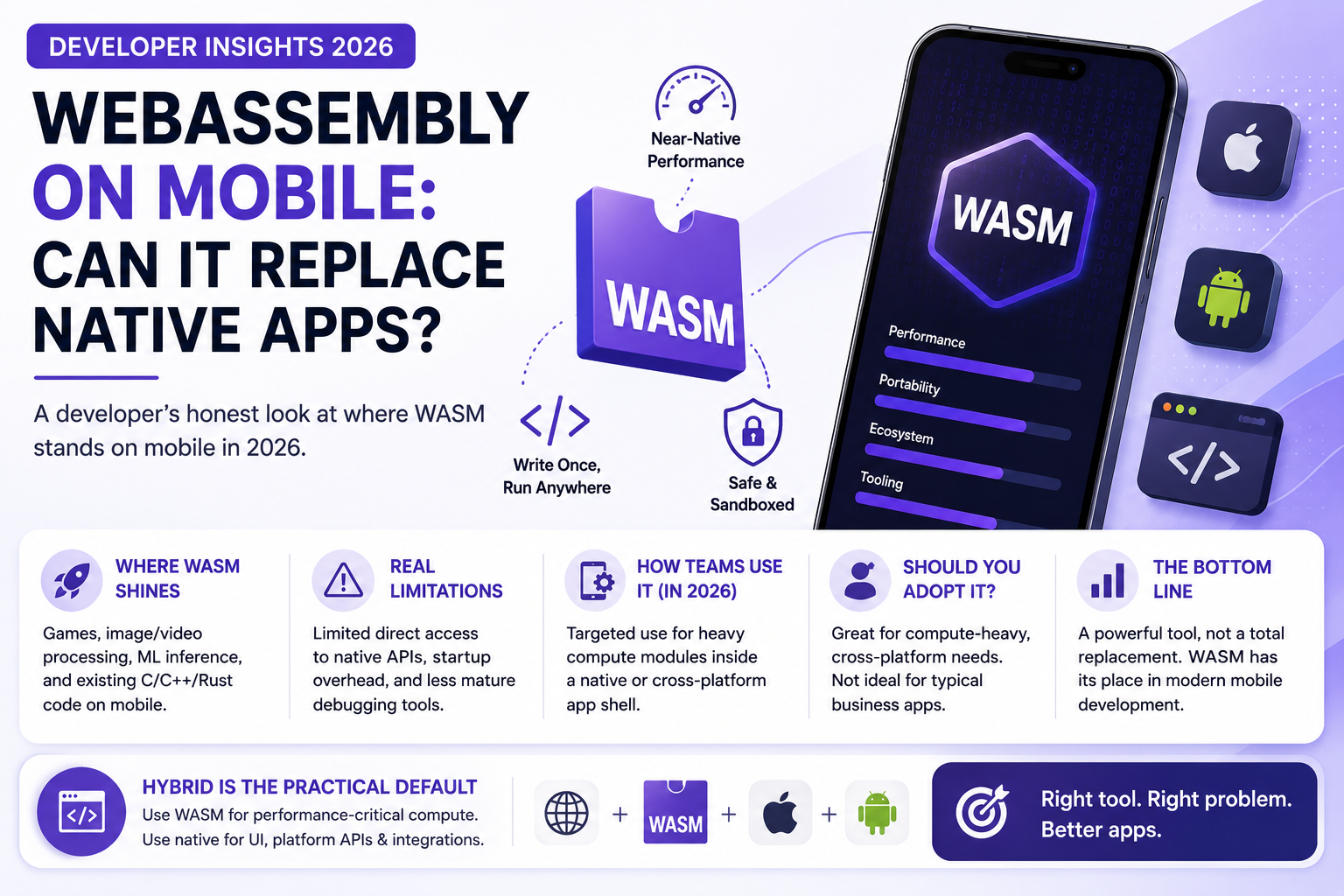
WebAssembly’s strongest mobile use case remains bringing existing, performance-critical C, C++, or Rust codebases onto phones without a full rewrite, which has made it particularly valuable for games, image and video processing libraries, and scientific computing applications that already have a mature native codebase elsewhere. Compute-heavy tasks that would be painfully slow running as interpreted JavaScript, physics simulations, audio processing, certain machine learning inference workloads, see genuinely substantial speedups when compiled to WASM instead. Several cross-platform game engines and creative tools have adopted WASM specifically for this reason, running a shared compute core across web, iOS, and Android without maintaining three separate performance-critical codebases.
The Real Limitations in Production
Despite genuine progress, WASM on mobile still runs into real friction that pure native development doesn’t face. Direct access to platform-specific APIs, camera controls, biometric authentication, deep OS-level integrations, still generally requires bridging out to native code anyway, which undercuts some of the write-once appeal for apps that lean heavily on those platform-specific features. Startup time and memory overhead, while improved considerably from WASM’s earlier years, still tend to lag behind fully native equivalents for apps with complex initial state, and debugging a WASM module running inside a mobile runtime remains noticeably less mature than debugging native iOS or Android code with each platform’s own first-party tooling.
How Teams Are Actually Using It in 2026
The pattern that’s emerged among teams shipping WASM on mobile in production isn’t full-app WASM adoption, it’s targeted use for specific, compute-heavy modules embedded inside an otherwise native or cross-platform app shell. A team might compile a shared image-processing or physics engine to WASM and call it from native Swift or Kotlin code, getting the performance and cross-platform code-sharing benefit for that specific component while keeping the surrounding app, navigation, platform integrations, UI, fully native. This hybrid pattern mirrors what’s happened with on-device AI more broadly this year: rather than a wholesale platform shift, WASM has found its niche as a targeted performance tool embedded within a broader native or cross-platform architecture.
Should Your Team Actually Adopt It
For teams with an existing performance-critical native codebase that needs to run across web and mobile without three separate rewrites, WASM remains a genuinely strong option worth serious evaluation in 2026, particularly for games, creative tools, and compute-heavy processing libraries. Teams building a typical business or consumer app with fairly standard UI and platform integration needs are unlikely to see meaningful benefit from adopting WASM specifically, since the complexity it introduces isn’t justified without a genuine compute-bound bottleneck to solve. As with most specialized technology adoption decisions, the right question isn’t whether WASM is good, it clearly is for the right workload, but whether a specific app actually has the kind of performance-critical, cross-platform compute problem that WASM was built to solve.
Looking at the broader arc of WebAssembly’s journey on mobile, the honest assessment in 2026 is similar to where on-device AI has landed: a genuinely useful, mature technology for a specific, real category of problems, rather than the platform-replacing revolution some of its earliest advocates predicted. The teams getting real value from it are the ones treating it as a targeted tool for sharing performance-critical compute code across platforms, not as a wholesale replacement for native app development. As tooling and debugging support continue to mature, expect WASM’s practical footprint on mobile to keep growing steadily, but a full displacement of native development looks unlikely to happen on any near-term horizon.
Conclusion
WebAssembly on mobile has made real, measurable progress in 2026, and for the right kind of performance-critical, cross-platform workload, it remains one of the more genuinely useful tools a mobile team can reach for. It hasn’t replaced native development, and the honest evidence suggests it isn’t trying to in any comprehensive sense, but as a targeted solution for sharing compute-heavy code across web and mobile platforms, WASM has firmly earned its place in a serious mobile developer’s toolkit this year.