Android roundups are among the most read and most trusted content in the app discovery ecosystem. “Best new Android apps this week.” “Top productivity apps for Android in 2026.” “Apps you missed this month.” Readers trust them because the filtering work has already been done – someone watched the Play Store, read the press, checked the submissions, and surfaced the ones actually worth downloading.
Getting into a roundup is not luck. It is not about having the most downloads or the biggest marketing budget. It is a system – and most developers do not know what that system looks like from the inside.
Here is exactly how to get your app into an Android roundup – from how editors find candidates to how to pitch correctly to what gets an app dropped from a draft list the morning before publication.
How Roundup Editors Actually Find Apps
Most developers assume roundup editors spend their working hours browsing the Play Store new releases section. Some do – briefly. But the Play Store new releases feed is a firehose of thousands of apps every week, the majority of which are low quality, abandoned within months, or indistinguishable from what already exists. Experienced roundup editors rely on a smaller set of sources where the noise-to-signal ratio is far better.
Dedicated Android press platforms. Apps that have already been through an editorial submission process – described clearly, verified by a platform team, published with proper metadata and a press release – are pre-qualified candidates for roundup inclusion. Roundup editors monitor these platforms specifically because the work of basic verification has already been done. An app that appears there is more likely to be real, active, and worth the editorial effort of including than an app that only exists in the Play Store new releases feed.
Community discussion with organic engagement. Posts in r/androidapps, r/AndroidGaming, and category-specific subreddits that generate genuine conversation – user questions, experience sharing, organic recommendations between community members. Not promotional posts that receive three upvotes and no comments. The distinction is easy to see and roundup editors read these communities regularly.
Direct developer pitches in the correct format. A small but meaningful percentage of roundup content comes from developer outreach. When a pitch arrives in the format an editor expects – short, specific, every required link present, press release already published – it gets considered in the current cycle. When it arrives as a generic promotional email with no structure and no assets, it gets archived without a response.
Understanding these three sources tells you precisely where to direct your pre-launch and launch energy. AppsMirror’s weekly Android roundup draws from all three – and apps that appear in multiple sources simultaneously are substantially more likely to be included than apps that appear in only one.
Why a Published Press Release Is the Non-Negotiable Entry Ticket
Roundup editors do not have time to independently verify every claim a developer makes about their app before including it. When an app appears in a roundup, the publication’s editorial credibility is attached to that inclusion. If the app turns out to be abandoned, broken, or misrepresented in its description, readers lose trust in the roundup itself – and reader trust is the only asset a roundup publication has.
This is why a press release published on a dedicated platform functions as the entry ticket to roundup consideration – not a supporting nicety but a functional requirement for serious editorial platforms.
When an editor sees that an app has been covered on androidnewswire.com – a dedicated Android press and developer platform – it signals a specific set of things simultaneously: the app is real and live on the Play Store, the developer has invested meaningfully in the launch, the basic claims about the app have been through at least one editorial checkpoint before publication, and a permanently indexed reference document exists that can be cross-referenced in seconds. Developers who submit through the platform’s App Launch Service benefit from exactly this editorial credibility, since the release is structured and distributed in a way that meets the standards editors and aggregators already recognize. That combination of signals removes the friction from the inclusion decision. The editor does not have to do the verification work independently. The groundwork has already been laid.
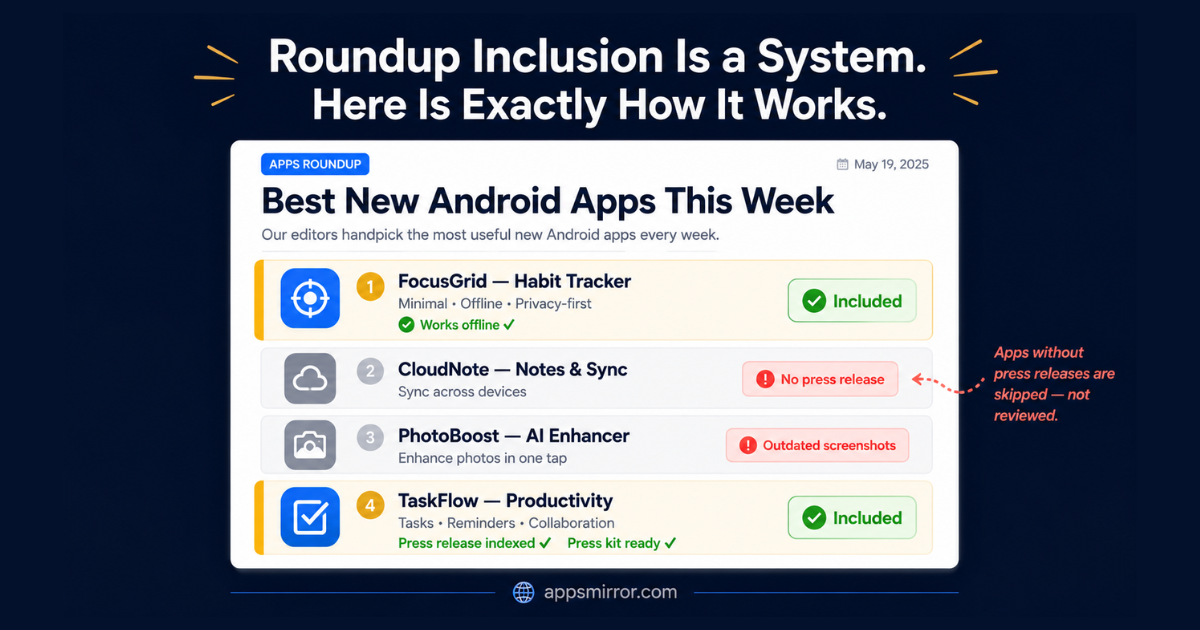
Apps without any prior press presence require significantly more editorial effort to include responsibly. In a weekly roundup built to a publication deadline, that additional effort almost always means the app gets skipped in favour of one that is easier and faster to verify. This is not a barrier that disadvantages good apps – it is a filter that protects roundup readers from half-finished products and launches that have not been taken seriously.
The Pitch Email Format That Actually Works
Most developer pitch emails to roundup sites fail for the same reasons across every submission inbox we have seen: too long, wrong structure, and missing the links an editor needs in the first ten seconds of reading. A roundup pitch email has one job – give the editor everything they need to decide whether to include your app, without asking them to do any additional work.
The format that consistently converts to inclusion:
Subject line: [App Name] – [Category] for Android – [One differentiating fact]
Example: FocusGrid – Habit Tracker for Android – Works Fully Offline, No Account Required
The subject line earns the open. It names the app, identifies the category, states the platform, and gives one specific fact that distinguishes this app from others in the same category. An editor reading that subject line in a full inbox knows immediately whether this app is relevant to their current roundup topic.
Body – four short sections only:
What it is (two sentences): App name, what it does, who it is for, price.
What makes it different (one to two sentences): The specific functional difference from the other five apps in its category. Not “it is better” or “it is more intuitive” – a concrete, verifiable claim. “Works entirely offline with no data collected” is concrete. “A seamless experience” is not.
Links (three lines):
– Play Store: [URL]
– Press release: [URL]
– Press kit (icon, screenshots, feature graphic): [URL]
Media contact (two lines):
– Name and branded email address only
That is the complete pitch – under 150 words, four sections, three links. No opening pleasantries, development backstory, feature list that duplicates the press release. The press release and press kit contain everything an editor needs to write about the app. The pitch email’s only job is to earn the click to those materials. Developers who follow this format have their pitches read and considered. Developers who do not have them archived. You can see the type and quality of apps that make our roundup consideration queue by browsing recent editions – the pattern of what gets covered is not random.
Timing Your Pitch to the Roundup Cycle
Most Android roundup publications operate on a weekly or monthly publication schedule. Pitching at the wrong point in that cycle means your app misses the current edition and has to wait for the next one – by which time the “new launch” angle has weakened and other apps have filled the available slots.
Three rules for roundup pitch timing that every developer should understand before their first outreach:
Rule 1 – Pitch mid-cycle, not at the deadline. A publication that publishes its weekly roundup every Friday is most receptive to pitches arriving Monday through Wednesday. That window gives the editor enough time to review, verify, and slot the app into the current edition without being rushed. Pitching Thursday afternoon for a Friday roundup is asking an editor to make a fast decision under deadline pressure. Those decisions default to no.
Rule 2 – Your launch window is two weeks, not one day. An app launched on June 10 can still be legitimately pitched as a new Android app to a roundup on June 21. The “new” window is longer than most developers assume. Use the full two weeks and pitch multiple relevant publications at different points in their cycle rather than sending everything out simultaneously on launch day.
Rule 3 – Monthly roundups need earlier pitches than weekly ones. A publication building a monthly digest is assembling that list throughout the entire month. Pitching in the first week gives your app the full consideration window. Pitching in the last three days of the month means competing with a backlog of submissions that arrived earlier and have already been reviewed.
What Gets an App Dropped From a Roundup Draft
Roundup editors cut entries from draft lists right up to the moment of publication. These are the most consistent reasons an app gets removed after initially being considered for inclusion:
Inconsistency between press release and Play Store listing. If the press release describes the app as free and the Play Store listing shows a paywall blocking access to core features, the app is cut. Every factual claim in your press materials must match your actual listing – price, features, compatibility, content rating. Editors check this before finalising any entry.
Outdated screenshots. An app that has clearly received UI updates but whose press kit still shows the old interface signals that the developer does not maintain their marketing materials. Roundup editors do not publish outdated screenshots – they reflect poorly on the publication that chose to include them. Update your press kit every time your app UI changes significantly.
No response to an editor’s follow-up query. Roundup editors sometimes have a quick clarifying question before confirming an entry – a pricing clarification, a higher-resolution asset request, a compatibility question for a specific Android version. If the developer does not respond within 24 to 48 hours, the slot goes to the next app on the list. Monitor your media contact email actively throughout your two-week launch window – not just on launch day.
App crashes on the editor’s device. This happens more frequently than developers expect. Test your app on a minimum of three Android versions before your launch window opens. A crash on an editor’s device during a review session results in a removed listing and a damaged relationship with that publication that affects future submissions too.
The Roundup Inclusion Checklist
| Item | Status | Why It Matters |
|---|---|---|
| Press release published on at least one indexed Android press platform before pitching | Required | Entry ticket – removes verification friction for the editor |
| Press kit live at a permanent public URL – icon, feature graphic, screenshots all current | Required | Editors need assets to publish without a follow-up request |
| Play Store listing matches press release on every factual claim | Required | Inconsistency is the most common cause of last-minute cuts |
| Pitch email in four-section format, under 150 words, three links included | Required | Wrong format means archived without reading |
| Pitch timed to mid-cycle for weeklies, first week for monthlies | Required | Deadline-day pitches default to the next edition |
| Media contact email monitored daily during two-week launch window | Required | Unanswered follow-up queries cost confirmed inclusions |
| App tested on minimum three Android versions before launch | Required | A crash on the editor’s device ends the review immediately |
Roundups are how apps travel beyond the audience a developer already has. A single inclusion in a well-read weekly digest can deliver more qualified downloads in 48 hours than a month of social media posting – because the reader’s decision to trust the roundup is already made before they see your app. The developers who understand this build their launch strategy around earning that inclusion consistently, not hoping for it occasionally. Submit your app for AppsMirror roundup consideration via our submission page – include your press release link and press kit URL in the first message.
Frequently Asked Questions
How many roundup publications should a developer pitch at launch?
Five to ten targeted roundup publications is a practical launch-window target for most Android apps. The key word is targeted – pitch publications that cover your specific app category or that have a demonstrated track record of covering apps at your maturity stage. A generic pitch to 50 publications produces worse results than a specific, well-timed pitch to eight that are genuinely relevant to your category and audience. Quality of targeting consistently outperforms volume of outreach in roundup submission conversion rates.
Can I pitch the same app to multiple roundup publications simultaneously?
Yes – roundup pitches are not exclusive in the way that feature article pitches sometimes are. Multiple publications can cover the same app in their respective roundups without conflict, and simultaneous coverage from several outlets on launch week is exactly the goal of a well-executed roundup outreach strategy. Stagger your pitches slightly by timing them to each publication’s mid-cycle window rather than sending everything on the same day – this avoids a simultaneous flood and improves the chance of mid-cycle consideration at each publication independently.
What is the minimum press kit content required for roundup submission?
Four elements cover the minimum that roundup editors need to publish an entry without a follow-up request: app icon at 1024×1024 PNG with transparent background, feature graphic at 1920×1080, four to six full-resolution screenshots of real UI (not mockups), and a one-paragraph plain-text app description in third person that editors can paste directly. Host all four at a single shareable URL – a Google Drive folder is sufficient. A press kit that requires a download or registration to access will not be used.
How long after an app’s Play Store launch can it still be pitched as a new app to roundups?
Two weeks is the practical window for most weekly and monthly Android roundups. An app published on June 10 can still be credibly described as a new Android app release in a roundup published on June 21. Beyond two weeks the “new launch” angle weakens significantly, though the app can still be pitched for category-specific roundups (“best offline Android apps” or “top budget trackers for Android”) where recency is less important than category fit. Major app updates that add significant new functionality can also be pitched as a re-launch with a fresh press release.
How does AppsMirror select apps for its weekly roundup?
Our weekly Android roundup draws from three sources: apps submitted through our submission page with a complete press release and press kit, apps discovered through dedicated Android press platforms and community discussion, and apps identified through our own Play Store monitoring. Apps submitted with a published press release link receive priority consideration. Apps submitted without a press release, without a press kit, or with screenshots that do not match the current version of the app are not included in the current edition.
AppsMirror rounds up the best new Android apps every week. Submit your app for roundup consideration via our submission page. Include your press release link and press kit URL in your first message.