
Google has been steering Android development toward Jetpack Compose for several years now, and by 2026 it’s mature enough that most new apps reasonably start there rather than with the older XML-based View system, but the question of whether new Android developers should learn Compose or XML first still comes up constantly in developer communities and job interviews alike. The honest answer mirrors the equivalent debate on iOS, both approaches have a legitimate place depending on the codebase and team involved, and treating this as a permanent either-or choice misses how most real Android teams actually work in practice today. This breakdown looks at where each approach genuinely excels rather than repeating Google’s official marketing framing wholesale, since real-world tradeoffs rarely match a keynote slide perfectly.
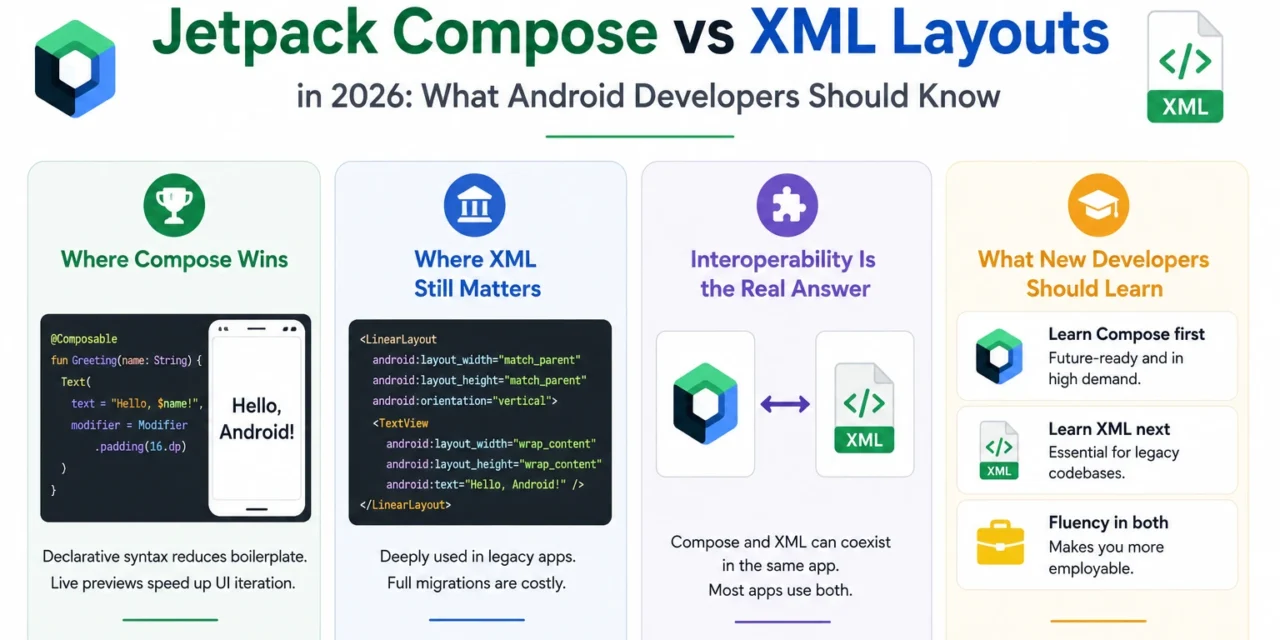
Where Compose Wins
Jetpack Compose’s declarative syntax cuts down dramatically on boilerplate compared to XML plus corresponding Kotlin binding code, and its live preview tooling speeds up UI iteration noticeably faster than the older build-and-inspect XML workflow.
Where XML Still Matters
XML layouts remain deeply embedded in large legacy Android codebases that predate Compose entirely, and migrating a mature production app wholesale is rarely worth the engineering effort compared to building new screens in Compose going forward.
Interoperability Is the Real Answer
Google built genuinely solid interoperability APIs specifically so Compose and XML views can coexist within the same app, meaning most production Android codebases in 2026 mix both rather than requiring an all-or-nothing migration.
What New Developers Should Actually Learn
New Android developers are generally better served learning Compose first given Google’s clear long-term direction and growing job market demand, then picking up XML fundamentals once they encounter a legacy codebase that still relies on it heavily.
Team context ends up mattering just as much here as it does in the equivalent iOS debate, since a developer joining a company maintaining a mature, years-old XML-based app will get more immediate practical value from strong XML and View system fundamentals than from advanced Compose techniques the codebase doesn’t even use yet. Startups and newer Android codebases increasingly default to Compose-first architecture, making it the more directly employable skill for developers specifically targeting early-stage companies and modern job listings. Freelancers and contractors benefit from genuine fluency in both, since client codebases vary enormously in age, and turning down otherwise good work over a framework gap remains an avoidable problem. Studying Google’s own official Compose samples alongside real production codebases on GitHub tends to reveal practical rough edges, particularly around complex list performance and nested scrolling, faster than documentation alone ever does. Reviewing Google’s yearly IO conference updates on Compose is also worth the time investment, since the framework’s rough edges tend to get addressed fairly quickly release over release.
Jetpack Compose has matured enough by 2026 that it’s a reasonable default for most new Android projects, but XML and the View system remain genuinely relevant for anyone working on established, large-scale codebases built before Compose existed. The most employable Android developers treat fluency in both as a practical asset rather than picking a permanent side in what’s really just a tooling debate. Teams hiring should also weigh this fluency over strict specialization, since most real Android work today involves at least occasional exposure to both, and demanding narrow specialization in only one shrinks the realistic hiring pool unnecessarily for teams and candidates alike.