
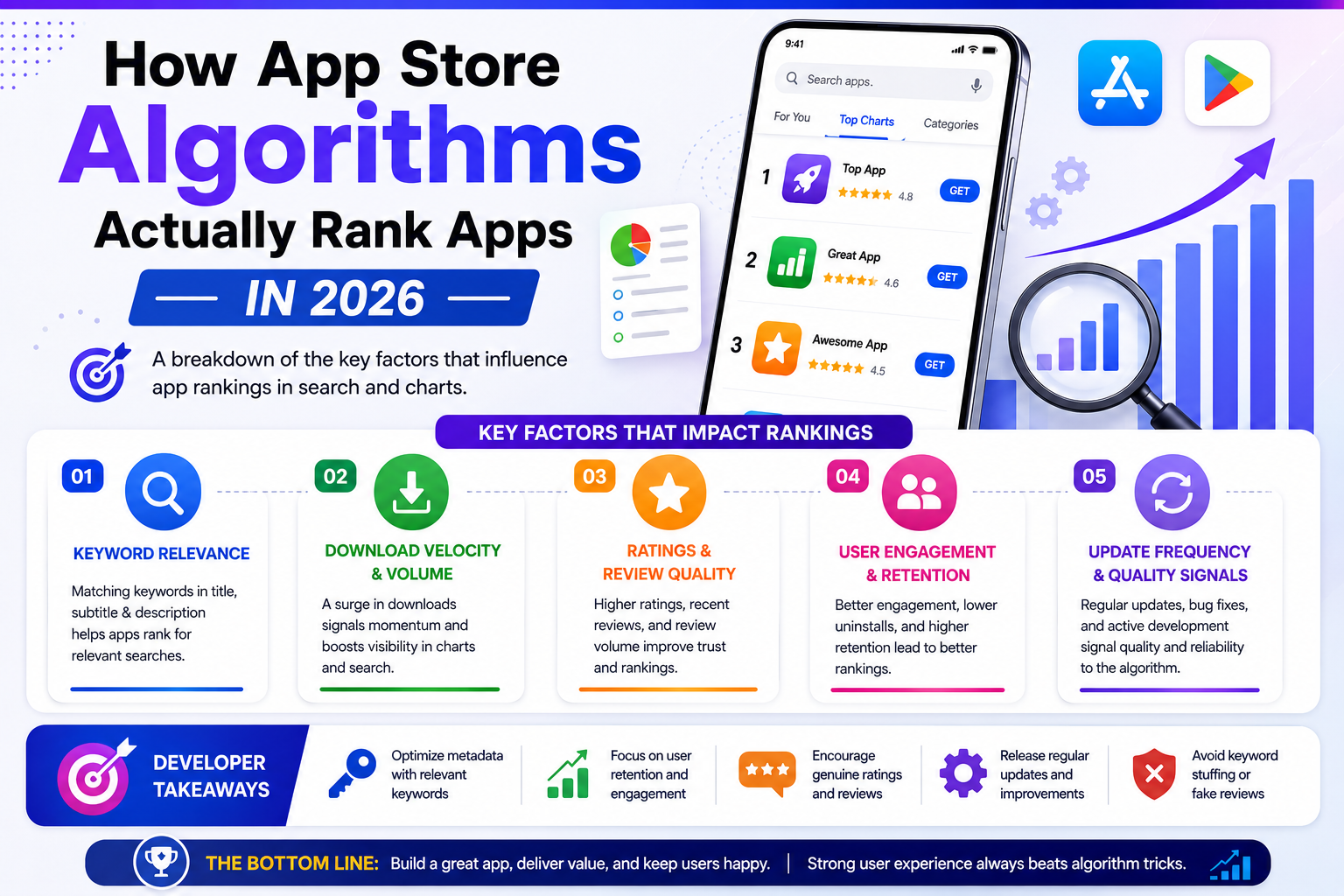
Neither Google nor Apple publishes the exact formula behind their app store rankings, but years of developer testing, official guidance, and observed ranking shifts have given the industry a fairly clear picture of what actually moves the needle. Understanding these factors matters for any developer trying to grow organic downloads without relying entirely on paid acquisition, since ranking well in search results remains one of the most cost-effective ways to reach new users over the long run. Both platforms have also grown more sophisticated at detecting manipulation, making a genuine understanding of legitimate ranking factors more valuable than ever. Here’s a breakdown of what genuinely influences app store rankings in 2026, based on consistent patterns developers and ASO specialists have observed across both major platforms.
Keyword Relevance in Metadata
Both stores weigh how well an app’s title, subtitle, and description match a searched term, though keyword stuffing beyond natural, readable placement tends to backfire rather than help, since both platforms have gotten better at penalizing obviously manipulative listings.
Download Velocity and Volume
A sudden spike in downloads relative to an app’s normal baseline signals genuine momentum to the algorithm, which is part of why launch-day promotion pushes and featuring placements can create a compounding snowball effect on visibility.
Ratings and Review Quality
Average rating matters, but review recency and volume matter nearly as much, an app with consistently positive recent reviews tends to outrank one with a similar average rating built entirely from reviews left years ago.
User Engagement and Retention
Both platforms increasingly factor in what happens after the download, apps with high uninstall rates or low day-one retention tend to see their rankings suffer even if the initial download numbers looked strong.
Update Frequency and App Quality Signals
Regularly updated apps tend to rank more favorably than abandoned ones, partly because updates often come with bug fixes that improve stability metrics the algorithm also considers, and partly because active development itself appears to be a weighted signal.
What This Means for Developers Trying to Improve Rankings
The clearest actionable takeaway from these patterns is that ranking well isn’t purely about gaming metadata, it’s increasingly about building an app that genuinely retains users and earns authentic positive reviews, since both platforms have invested heavily in detecting and penalizing artificial engagement or reviews. That shift rewards developers focused on genuine product quality over pure ASO tactics, though smart keyword placement in titles and descriptions still provides a real, legitimate boost when done honestly rather than through stuffing. Developers should also pay attention to post-launch metrics specifically, since a strong launch with poor retention can actually hurt long-term ranking more than a slower, steadier growth curve with users who genuinely stick around. Tracking these signals over months rather than days gives a far more accurate read on what’s actually working than reacting to short-term ranking fluctuations alone.
App store algorithms have grown considerably more sophisticated at detecting genuine quality signals versus manipulated ones, which is ultimately good news for developers building apps people actually want to keep using. Focus on the fundamentals, clear and honest metadata, a genuinely good onboarding experience that retains users, and consistent updates, rather than chasing algorithm tricks that tend to have a shorter shelf life than the underlying quality signals both platforms are increasingly built around. Building for genuine user satisfaction first tends to produce better long-term rankings than optimizing for the algorithm directly ever does.