
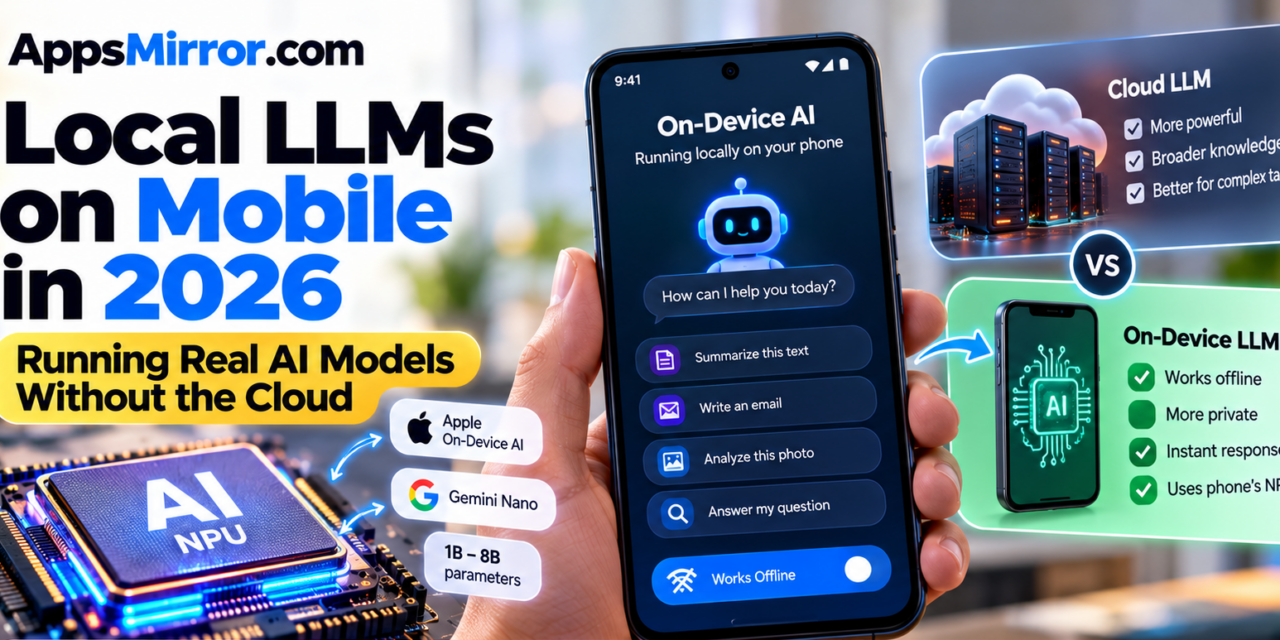
Running a genuine language model entirely on a phone, with no network round trip to a cloud API required, sounded close to science fiction just a couple of years ago, given how much compute a large language model traditionally demanded. By 2026, thanks to aggressive model quantization techniques and mobile chips specifically designed with AI acceleration in mind, genuinely capable smaller language models now run directly on flagship phones, though real limitations remain compared to their considerably larger cloud-hosted counterparts. Here’s an honest look at where local LLMs on mobile actually stand this year.
What’s Actually Running Locally Now
Quantized versions of genuinely capable smaller language models, typically in the 1 to 8 billion parameter range, now run directly on modern flagship phone chips with dedicated neural processing units, handling tasks like text summarization, basic question answering, and simple content generation entirely on-device without any network call at all. Apple’s on-device intelligence framework and Google’s Gemini Nano both represent genuine production examples of this pattern, powering specific on-device features like text suggestion and summarization directly within the operating system rather than routing every request to a cloud server. These models are genuinely smaller and less capable than the frontier cloud models powering something like a full conversational assistant, but they’re real, working language models running with zero cloud dependency, not merely simple pattern matching.
The Genuine Capability Gap That Remains
The most consistently honest limitation is genuine capability: a quantized, mobile-sized model, however impressive relative to what ran locally even a year or two earlier, still falls meaningfully short of a full-scale cloud model’s reasoning depth, factual breadth, and ability to handle a genuinely complex, multi-step request. Battery and thermal considerations remain real too, since sustained on-device inference genuinely taxes a phone’s battery and can trigger thermal throttling during an extended session, a constraint a cloud-hosted model simply doesn’t impose on the requesting device at all. Memory constraints also genuinely limit how large a model a phone can practically hold in memory alongside everything else already running, meaning developers need to make real tradeoffs between model capability and the amount of device resources a specific feature can reasonably consume.
Where On-Device Genuinely Makes Sense
The clearest genuine production use cases involve privacy-sensitive processing where sending data to a cloud server raises real user concern, personal message drafting suggestions, on-device photo analysis, or health-related text processing where keeping data entirely on the device matters considerably to users. Offline functionality represents another genuinely strong use case, letting a specific AI feature keep working during a connectivity gap, a flight, a remote area, a spotty connection, rather than failing entirely without an active internet connection. Latency-sensitive features that need an instant response, real-time text prediction or simple classification tasks, also genuinely benefit from on-device processing’s elimination of network round-trip time, a real, measurable difference for anything requiring instant feedback.
Should Your App Actually Use a Local Model Now
For features specifically requiring privacy-sensitive processing, offline functionality, or genuinely instant latency, and where a smaller, quantized model’s more modest capability is honestly sufficient for the specific task at hand, on-device LLM inference remains a legitimate, increasingly well-tooled option in 2026 worth serious evaluation. For features genuinely requiring deep reasoning, broad factual knowledge, or handling complex, open-ended requests, a cloud-hosted frontier model remains considerably more capable, and forcing that kind of task onto a smaller on-device model will likely produce a genuinely worse user experience than simply making the cloud API call. As with most technology adoption decisions, the right question isn’t whether on-device AI is impressive, it clearly is given how far it’s come, but whether a specific feature’s actual capability requirements and privacy or latency needs genuinely justify the real tradeoffs on-device inference still involves.
Looking at where local LLMs on mobile actually stand after genuine hardware and quantization advances through 2026, the honest assessment is that on-device inference has moved from a research curiosity into genuine production capability for a specific, real category of features, privacy-sensitive processing, offline functionality, instant-latency needs, while still falling meaningfully short of cloud-hosted models for tasks demanding genuine deep reasoning or broad knowledge. The teams getting real value from on-device models are matching a specific feature’s actual capability requirements against what a smaller, quantized model can honestly deliver, rather than assuming on-device processing is uniformly preferable simply because it avoids a cloud dependency. As mobile chip AI acceleration and quantization techniques continue improving, expect the practical capability gap to keep narrowing, though a meaningful difference between on-device and frontier cloud models will likely persist for the foreseeable future given the sheer compute gap between a phone and a data center.
Conclusion
Local LLMs on mobile have made genuine, hardware-backed progress in 2026, moving from an interesting research direction into real production capability for the specific category of privacy-sensitive, offline, or latency-critical features. It isn’t a wholesale replacement for cloud-hosted AI, and the capability gap for genuinely complex reasoning tasks remains real, but for the right kind of feature, this year’s mobile chips and quantization techniques have made on-device inference a legitimate, well-supported default rather than a futuristic aspiration.