
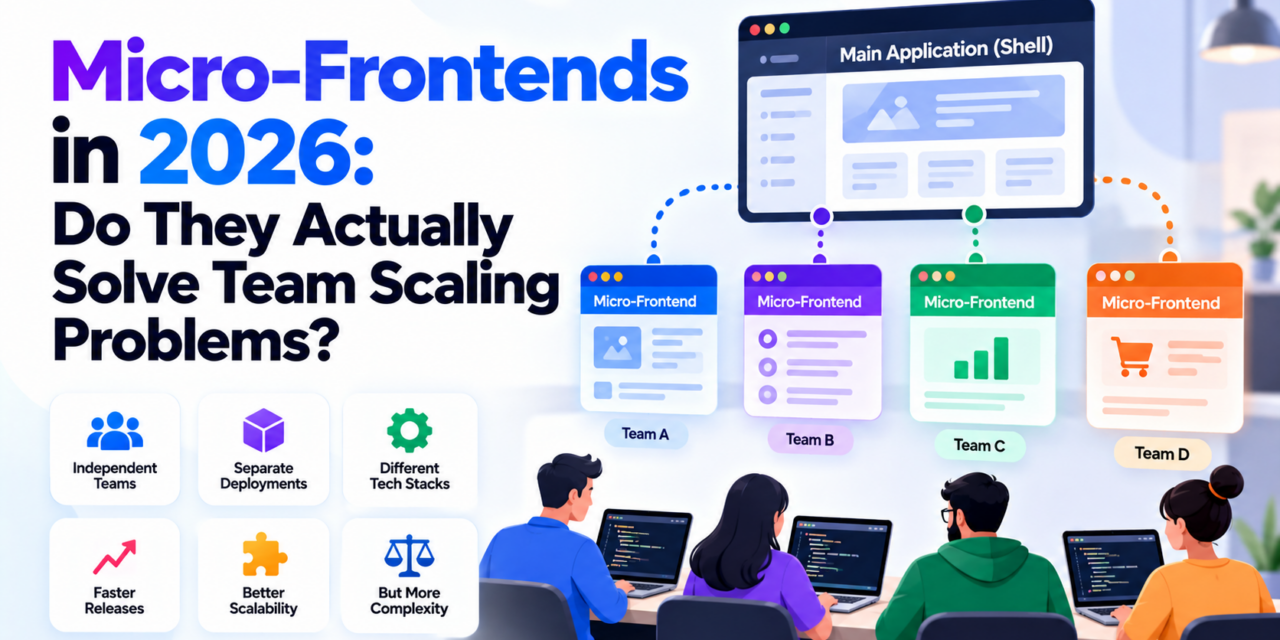
Micro-frontends extend the microservices philosophy to the browser, splitting a single large frontend application into smaller, independently developed and deployed pieces that different teams can own separately, each built and shipped without needing to coordinate a single, monolithic release. The pitch sounds genuinely appealing on paper, letting large organizations scale frontend development the same way microservices scaled backend development, but by 2026 enough companies have lived with this architecture in production that a genuinely honest picture has emerged of whether it actually delivers on that promise. Here’s an honest look at where micro-frontends actually stand this year.
What Micro-Frontends Actually Promise
The core value proposition addresses a genuinely real organizational problem: a single large frontend codebase owned by many different teams tends to create constant coordination overhead, shared dependency conflicts, and a release process where one team’s bug can block every other team’s deployment. Micro-frontends, implemented through techniques like Webpack Module Federation or build-time composition, let each team own a genuinely independent piece of the overall application, choosing their own release cadence and even their own internal tooling choices without needing sign-off from every other team sharing the codebase. This independence matters enormously for genuinely large organizations where dozens of separate teams need to ship frontend changes to the same overall product without constantly blocking each other.
The Real Complexity This Introduces
The most consistently cited cost is genuine runtime complexity: coordinating shared dependencies, a common design system, a shared authentication state, consistent routing, across independently built and deployed pieces requires real, ongoing architectural discipline that a single unified codebase simply doesn’t need to solve at all. Performance also genuinely suffers without careful management, since naively composed micro-frontends can end up shipping duplicate copies of shared libraries like React to the browser, a real, measurable performance cost that teams need deliberate tooling and governance to avoid. Testing an entire user journey that spans multiple independently owned micro-frontends becomes genuinely harder too, since a bug might only manifest at the exact boundary where two separately built pieces interact, a class of issue that’s considerably more difficult to catch than a bug within a single unified codebase.
Where This Genuinely Works in Production
The clearest production success stories consistently involve genuinely large organizations, typically hundreds of frontend engineers or more, where the actual coordination cost of a single monolithic codebase has become a real, measured bottleneck that outweighs the added architectural complexity micro-frontends introduce. Teams reporting genuine success describe investing seriously in shared tooling and governance upfront, a common design system, shared authentication handling, consistent build tooling, treating these shared concerns as first-class infrastructure investments rather than something each team figures out independently. Organizations at a more modest scale, dozens rather than hundreds of frontend engineers, consistently report that the coordination overhead micro-frontends introduce genuinely outweighs whatever team-independence benefit they were hoping to gain.
Should Your Team Actually Adopt This Now
For genuinely large organizations with dozens of separate teams contributing to the same overall frontend product, where team coordination has become a real, measured bottleneck that a single monolithic codebase can no longer support gracefully, micro-frontends remain a legitimate, if operationally demanding, architectural investment in 2026. Teams at a smaller or more modest scale, where a single, well-organized codebase with clear internal module boundaries can still be maintained without genuine cross-team coordination becoming a bottleneck, are very likely to find micro-frontends introduce meaningfully more complexity than they solve. As with most architectural decisions covered this year, the right question isn’t whether micro-frontends are a clever architectural pattern, they clearly can be for the right scale of organization, but whether a specific team’s actual coordination pain genuinely justifies the real runtime and testing complexity this pattern introduces.
Looking at where micro-frontends actually stand after genuine production use at scale, the honest assessment is that they solve a real, specific organizational problem, genuine cross-team coordination overhead at real scale, while introducing genuine new runtime and testing complexity that a smaller organization simply doesn’t need to accept. The teams getting real value from this architecture are those who hit a genuine, measured team-coordination bottleneck first and invested seriously in shared tooling and governance as a first-class concern, rather than adopting the pattern preemptively because it sounded architecturally sophisticated. As tooling around module federation and cross-micro-frontend testing continues to mature, expect the practical scale threshold for adopting this pattern to shift somewhat, but the fundamental tradeoff, team independence in exchange for real coordination and runtime complexity, will likely remain the honest calculation for the foreseeable future.
Conclusion
Micro-frontends have made genuine, if narrow, progress toward solving real team-scaling problems in 2026, delivering measurable value specifically for the largest organizations where cross-team coordination has become a genuine, quantifiable bottleneck. For the considerably larger share of teams operating at a more modest scale, the honest advice from organizations that have lived through this architecture consistently points the same direction: a well-organized monolithic codebase with clear internal boundaries remains the simpler, more reliable default until team coordination genuinely becomes the bottleneck this pattern was specifically built to solve.