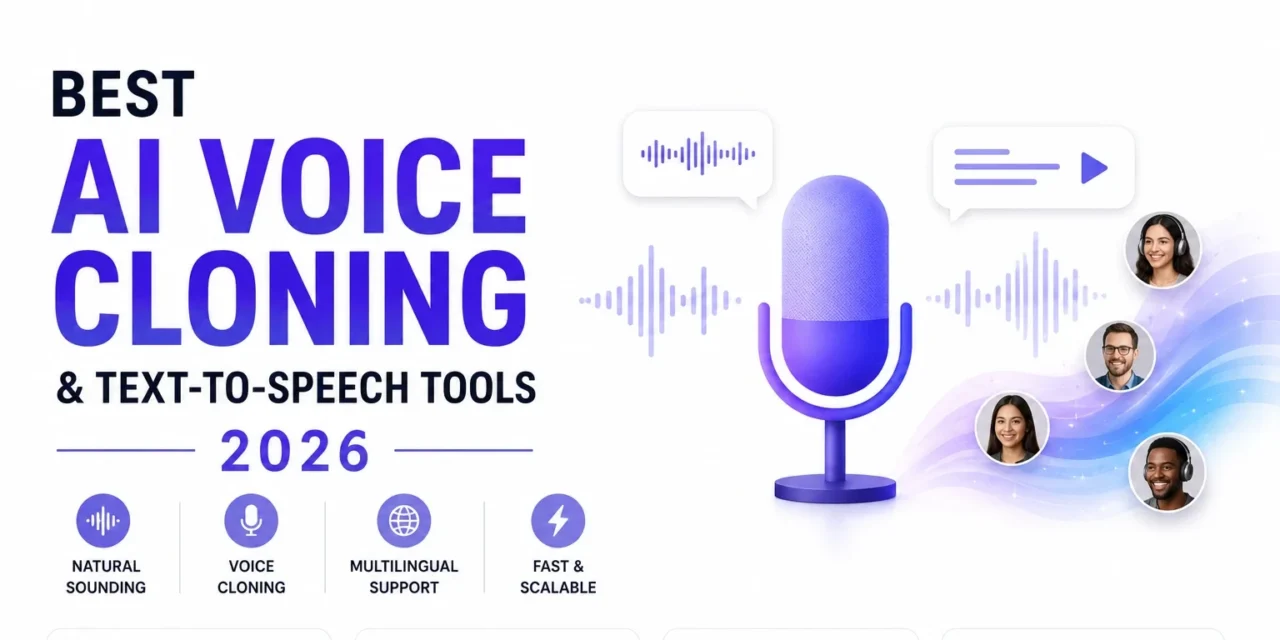
Text-to-speech used to reliably mean robotic, obviously computer-generated audio, but that era is genuinely over: modern AI voice generators now produce speech that most listeners cannot distinguish from a human recording in blind testing. That shift has opened up voice cloning and AI narration for podcasting, audiobook production, video voiceover, and multilingual dubbing at a fraction of the cost of traditional voice talent, while also raising real ethical questions about consent and misuse that any serious user should take seriously. Here’s a look at the strongest tools in this category this year.
ElevenLabs
ElevenLabs remains the clear quality leader in the category, valued at roughly $11 billion following a February 2026 funding round, with a proprietary model that captures subtle speech patterns, breath sounds, natural pauses, and tonal shifts, that other text-to-speech engines tend to flatten out entirely. Its voice cloning can produce a recognizable clone from as little as one minute of source audio, and its multilingual dubbing feature doesn’t just translate a script, it re-synthesizes the cloned voice in the target language with matching cadence and intonation across more than 32 languages. Priced from $5 to $330 a month depending on usage, it remains the top pick for anyone who needs voice quality that genuinely passes as human, though buyers should carefully review its data retention policies before cloning a personal voice.
Murf AI
Murf AI has built its reputation around business and professional content rather than chasing ElevenLabs’ absolute realism ceiling, offering a genuinely polished production environment with word-level emphasis control, pitch adjustment, timed pauses, and more than ten speaking styles per voice, alongside video sync tools and an 8,000-plus track music library. Its recently launched Falcon model delivers real-time voice generation with 55-millisecond latency, making it genuinely competitive with specialized real-time conversational platforms rather than just pre-recorded narration. Priced from $29 to $166 a month, it remains the strongest choice for marketing, e-learning, and corporate video narration specifically, where a clean, professional tone matters more than the most emotionally expressive performance possible.
PlayAI (formerly Play.ht)
PlayAI, rebranded from Play.ht in 2026, has expanded its focus from pure text-to-speech conversion toward conversational AI agents while still offering strong core voiceover capability across a voice library spanning more than 142 languages and 900-plus voices. Its economics favor high-volume content production over per-sample perfection, making it a strong fit for creators who need large amounts of narration generated efficiently rather than a single, meticulously crafted voiceover. Priced from roughly $31 to $99 a month, it remains a solid choice specifically for podcast-style and long-form audio content where consistent output at scale matters more than matching ElevenLabs’ absolute top-tier realism.
Descript (Overdub)
Descript’s Overdub feature clones a user’s own voice from a short training script and integrates that clone directly into Descript’s broader podcast and video editing suite, letting creators fix a flubbed line or add new narration in their own cloned voice without needing to re-record the original take. Its edit-by-text workflow, where deleting a word from the transcript removes the corresponding audio automatically, remains one of the more genuinely time-saving features in the entire audio editing category, and its Studio Sound tool cleans up background noise automatically as part of the same workflow. Descript made Overdub standard on all paid plans in 2026, removing the higher-tier paywall that previously restricted voice cloning to its most expensive tier, making it considerably more accessible for creators who primarily want to fix their own recordings rather than generate an entirely synthetic voice.
Visit Website
Choosing between these four largely comes down to the specific use case rather than one tool being universally best. Anyone who needs voice quality that genuinely passes as human, for audiobooks, character performance, or high-stakes narration, should default to ElevenLabs despite its higher price point, while businesses producing routine marketing or training video narration will likely find Murf’s polished, professional-toned output and production tooling a better everyday fit. Podcasters and long-form content creators producing high volumes of audio should look toward PlayAI for its favorable per-minute economics, and anyone whose primary need is fixing or extending their own voice within existing recordings, rather than generating a fully synthetic voice from scratch, will get the most direct value from Descript’s Overdub.
Conclusion
AI voice cloning and text-to-speech tools have crossed a genuine quality threshold in 2026, reaching a point where synthetic narration is good enough to replace traditional voiceover work for a large share of everyday content needs. Whichever of these four ends up being the right fit, the technology’s realism makes it more important than ever to use it responsibly, respecting consent around cloning any voice that isn’t explicitly authorized for the purpose.