
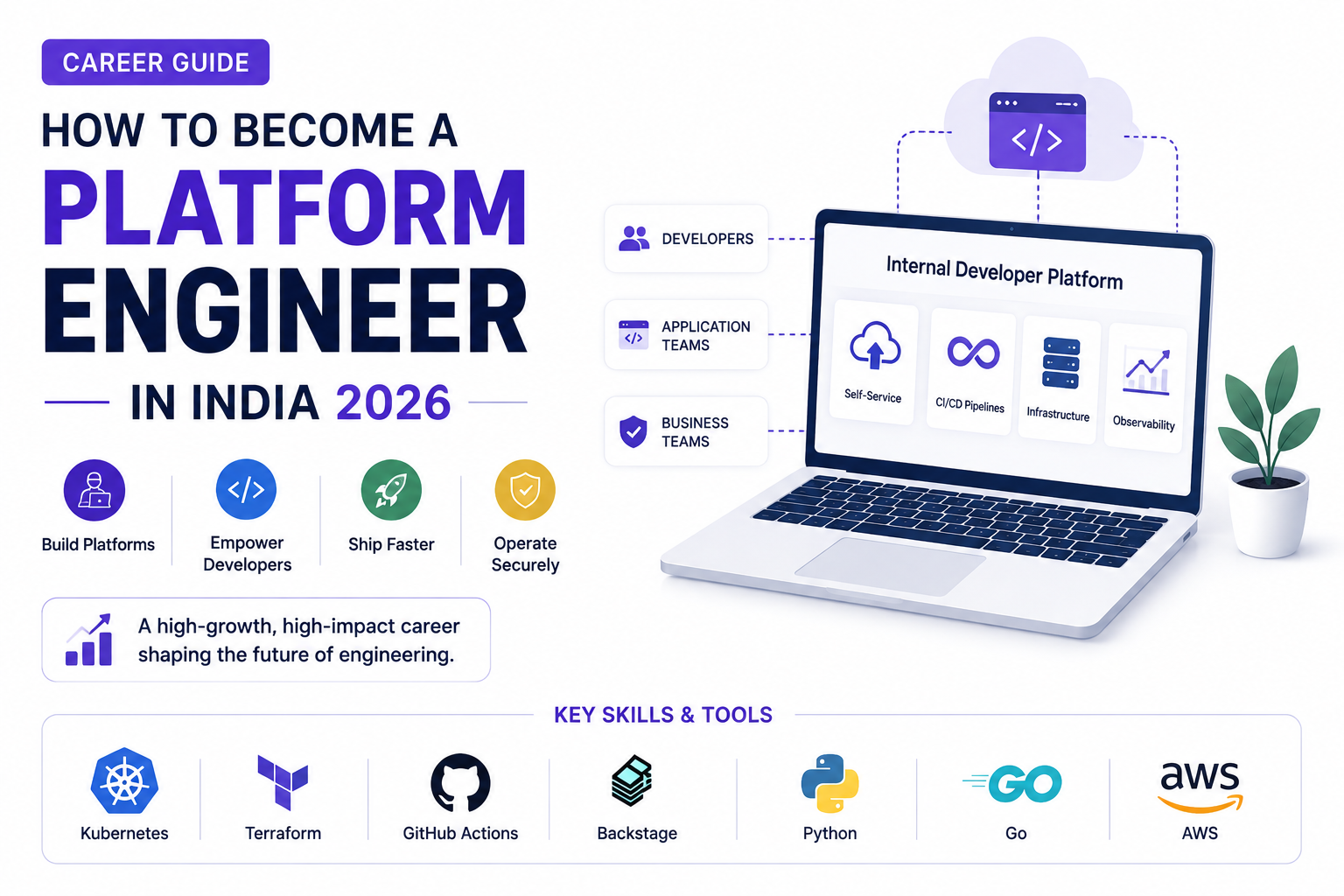
Platform engineering has emerged as one of the more clearly defined and rapidly growing specializations in India’s technology industry, evolving directly out of the DevOps and site reliability engineering movements as organizations realized that individual application teams shouldn’t each need to reinvent their own deployment pipelines, infrastructure provisioning, and internal tooling from scratch. A platform engineer builds and maintains the internal developer platform, the shared set of tools, self-service workflows, and infrastructure abstractions, that lets other engineering teams ship software faster and more safely without needing deep infrastructure expertise themselves. This guide breaks down what the role actually involves and how to build a credible path into it from India’s current tech landscape in 2026.
What a Platform Engineer Actually Does
A platform engineer’s core responsibility is treating internal developer experience as a genuine product, building self-service tools, standardized deployment pipelines, and infrastructure abstractions that other engineering teams consume directly rather than needing custom infrastructure work for every new project. This differs meaningfully from a traditional DevOps or site reliability engineering role, which tends to focus more on operating and maintaining specific production systems, while a platform engineer’s success is measured by how much faster and more safely other engineering teams can ship code using the platform’s own tools. Day-to-day work often involves building internal CLI tools, Kubernetes-based deployment abstractions, and self-service infrastructure provisioning systems that hide genuine underlying complexity behind a simple, well-documented interface for application developers.
Core Technical Skills Needed
Deep Kubernetes expertise remains close to essential for this role in India’s current market, since most modern internal developer platforms are built as abstraction layers on top of Kubernetes rather than replacing it entirely. Strong skills with infrastructure-as-code tools, particularly Terraform, alongside CI/CD pipeline design using tools like GitHub Actions, GitLab CI, or Jenkins, form the practical backbone of daily platform engineering work. Familiarity with a scripting or systems language, commonly Go or Python, matters considerably for building the actual internal tools and CLIs that make a platform genuinely self-service rather than just a set of documented manual steps, and growing familiarity with platform orchestration frameworks like Backstage, used to build internal developer portals, has become an increasingly common expectation even at the mid-level.
Certifications and Learning Path
Kubernetes-specific certifications carry real weight in this field, particularly the Certified Kubernetes Administrator and Certified Kubernetes Application Developer credentials from the Cloud Native Computing Foundation, both of which signal verified, hands-on Kubernetes competency to Indian employers evaluating platform engineering candidates. Cloud provider certifications, especially around AWS, Google Cloud, or Azure’s respective infrastructure and container services, round out the credentialing most companies look for alongside genuine Kubernetes depth. Because platform engineering is such a practically oriented discipline, building and documenting a real internal tool, even a personal project simulating a small internal developer platform, tends to carry more weight in interviews than certifications alone, and many successful platform engineers in India begin in a DevOps or site reliability engineering role before transitioning into a dedicated platform team as that specialization has matured within their organization.
Typical Career Path and Salary Expectations
Entry-level platform engineer roles in India’s major tech hubs currently see salaries ranging from roughly 9 to 16 lakhs per annum for candidates with strong Kubernetes and infrastructure-as-code fundamentals, with mid-level engineers holding three to six years of experience typically commanding 22 to 38 lakhs depending on company size and platform maturity. Senior platform engineers and platform leads at larger product companies or scaled engineering organizations can reach 50 lakhs and well beyond, particularly with deep expertise in a specialized area such as multi-cluster Kubernetes operations, internal developer portal design, or large-scale CI/CD system architecture. Demand for this specialization has grown particularly quickly among mid-sized and larger Indian product companies looking to formalize what was previously informal DevOps tooling work into a genuine dedicated platform team.
For engineers currently working in DevOps, site reliability engineering, or general backend development who want to transition into platform engineering, the most effective path tends to combine deep, hands-on Kubernetes and infrastructure-as-code work with a genuine product mindset, treating internal developers as real users whose experience matters rather than simply keeping infrastructure running. Volunteering to build even a small internal tool or self-service workflow at a current job, a deployment CLI, a standardized service template, an internal developer portal, builds exactly the kind of practical, product-oriented platform experience that distinguishes a credible candidate from someone with only traditional operations experience. Contributing to open-source platform engineering tooling, such as Backstage plugins or Kubernetes operators, can also meaningfully demonstrate this capability to employers evaluating candidates for a still-maturing specialization.
Conclusion
Platform engineering has become one of the more clearly defined and consistently well-compensated specializations to emerge from India’s broader DevOps and cloud infrastructure talent pool, sitting at the center of how modern engineering organizations scale their development velocity without scaling operational chaos alongside it. For engineers willing to build genuine depth in Kubernetes, infrastructure-as-code, and internal tooling, combined with a real product mindset toward developer experience, 2026 remains an excellent year to pursue this path, with demand continuing to grow steadily across India’s product engineering and scaled technology organizations.