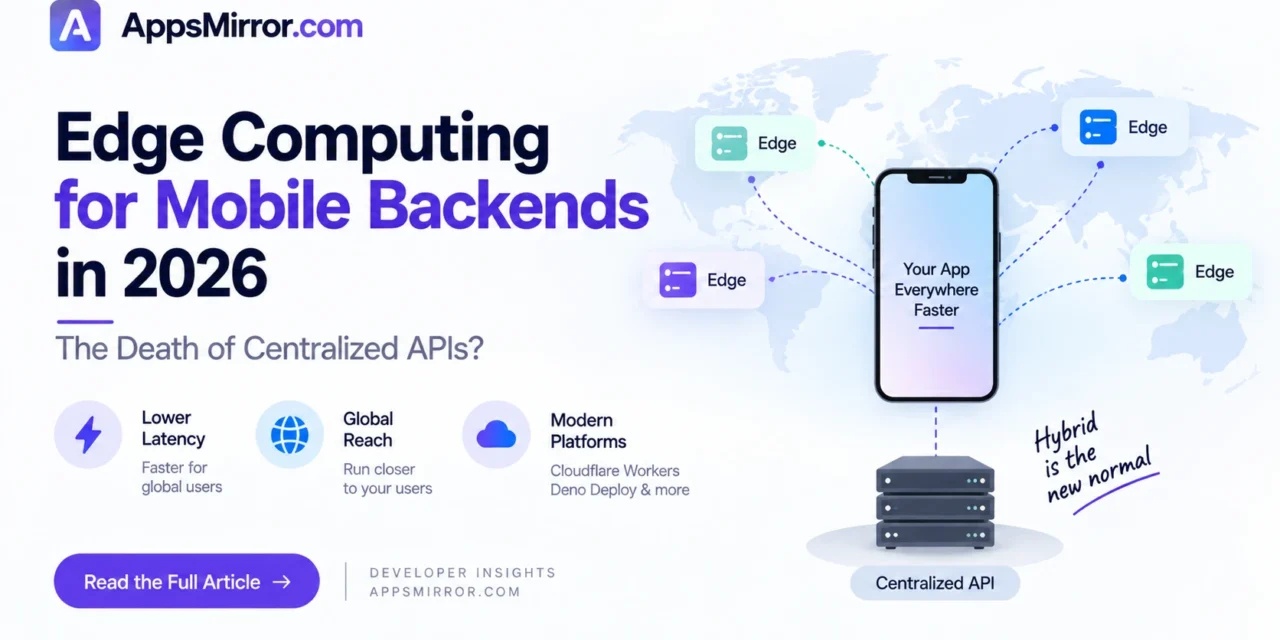
A mobile app’s users are almost always global, while its backend servers traditionally sit in one or two regions, meaning a user far from that region pays a real latency tax, often 150 to 200 milliseconds round trip, on every single API call. Edge computing platforms like Cloudflare Workers and Deno Deploy promise to eliminate that tax by running backend code in hundreds of locations worldwide rather than a handful of centralized data centers, and by 2026 these platforms have matured enough that serious teams are building genuine production mobile backends on them rather than just static content caching. Here’s an honest look at whether this actually means centralized APIs are dying for mobile backends, or whether the reality is more nuanced.
What’s Actually Mature Enough for Production Now
Cloudflare Workers has emerged as the clear leader in raw distribution and price-performance, running on more than 300 data centers globally using V8 isolates that deliver sub-millisecond cold starts, paired with a genuinely complete storage stack: D1 for SQLite-compatible edge databases, R2 for S3-compatible object storage, KV for eventually-consistent key-value data, and Durable Objects for strongly-consistent stateful workloads. Deno Deploy has carved out a strong alternative position specifically for teams that want a more web-standards-pure, TypeScript-first runtime, with its own Deno KV storage offering strong consistency within regions, a genuine advantage over Cloudflare KV’s eventual consistency for use cases where that distinction actually matters. It’s worth noting one important platform change directly relevant to anyone building on Deno: Deno Deploy Classic at dash.deno.com is being discontinued on July 20, 2026, so any new mobile backend project should build against the updated platform at console.deno.com rather than the legacy dashboard.
The Real Limitations Edge Platforms Still Have
Edge functions remain genuinely unsuited to long-running operations or heavy processing, since the entire model is built around isolates handling many short-lived requests quickly rather than sustained, resource-intensive work, meaning compute-heavy tasks like video processing or large batch jobs still belong on traditional origin servers rather than at the edge. Cloudflare’s V8 isolate model also can’t run npm packages that require genuine Node.js APIs, only a compatibility layer covering common cases, which means some existing backend libraries simply won’t run unmodified on Workers the way they would on a traditional Node server. Database access from the edge requires deliberate architecture too, since a mobile backend’s edge functions need to talk to edge-native databases like D1, KV, or R2 to actually realize the latency benefit, rather than still routing every database query back to one centralized origin database, which would simply move the latency bottleneck rather than eliminating it.
How Teams Are Actually Architecting Mobile Backends in 2026
The pattern that’s emerged among mobile teams building on edge platforms isn’t a wholesale replacement of a centralized backend, it’s a hybrid split: request routing, authentication checks, feature flags, A/B test assignment, and simple cached reads run at the edge for genuine latency wins, while heavier business logic, complex multi-table transactions, and anything requiring a traditional relational database still routes back to a centralized origin server. This mirrors the same hybrid pattern that’s emerged across nearly every other specialized technology covered this year, on-device AI, WebAssembly, server-driven UI, run the narrow, latency-sensitive piece at the edge or on-device, and fall back to centralized infrastructure for everything that genuinely needs it. Mobile apps specifically benefit from this pattern for API calls tied to a user’s immediate location or session state, while data that needs strong consistency across a user’s entire account still flows through a traditional centralized data layer.
Should Your Mobile Team Actually Adopt This Now
For mobile apps with a genuinely global user base where API latency measurably affects user experience, live features, real-time collaboration, anything where a 150-millisecond round trip is noticeable, evaluating Cloudflare Workers or Deno Deploy for the latency-sensitive slice of the backend remains a legitimate, well-supported architectural investment in 2026. Mobile apps with a geographically concentrated user base, or backends dominated by heavy, complex database operations rather than simple reads, are unlikely to see meaningful benefit from the added architectural complexity of splitting logic between edge and origin, since the latency problem edge computing solves simply isn’t the actual bottleneck for that kind of app. As with every specialized architecture pattern covered this year, the right question isn’t whether edge computing is impressive technology, it clearly is, but whether a specific mobile app’s actual user distribution and latency sensitivity genuinely justify the complexity of a hybrid edge-and-origin backend.
Looking at where edge computing for mobile backends actually stands in 2026, the honest answer to whether it’s killing centralized APIs is no, not in the dramatic, wholesale sense the framing suggests, but it has become a genuinely mature, production-ready tool for a specific and real problem: global latency for the narrow slice of API calls where speed measurably matters. The teams getting real value from Cloudflare Workers or Deno Deploy are treating edge functions as a targeted layer sitting in front of a still-centralized core backend, not as a full replacement for traditional server infrastructure. As edge-native database options continue maturing and the runtimes converge further on shared Web Standards APIs, expect this hybrid pattern to keep becoming the practical default for globally distributed mobile apps, without ever fully eliminating the centralized backend sitting behind it.
Conclusion
Edge computing has made genuine, production-ready progress for mobile backends in 2026, and for apps with a truly global user base and real latency sensitivity, platforms like Cloudflare Workers and Deno Deploy now offer a mature, credible way to close that gap. Centralized APIs aren’t dying, though, they’re being selectively supplemented: the mobile teams getting the most value from this shift are the ones routing the narrow, latency-critical slice of their backend to the edge while keeping heavier, more complex logic on traditional centralized infrastructure where it still belongs.